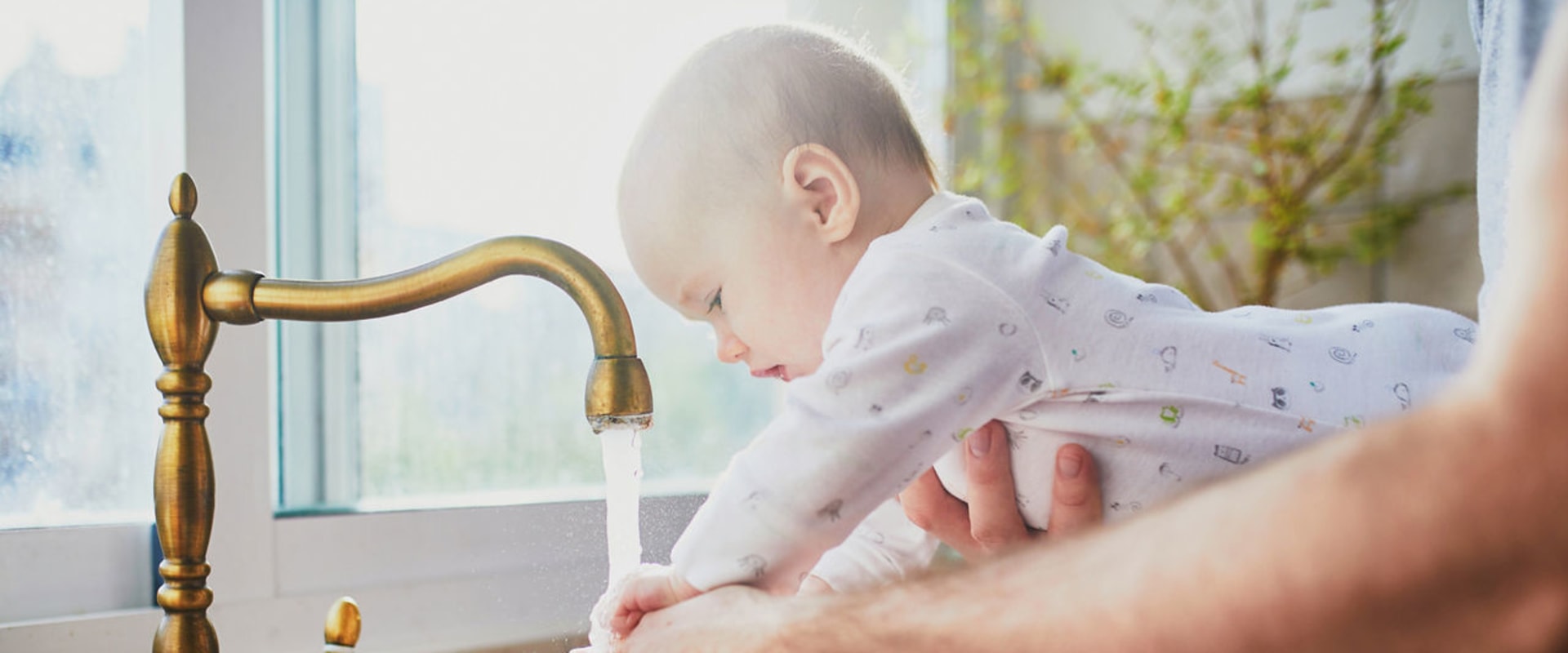
We didn't think about it either — until we became parents. As a dentist and a biomedical engineer, we understood skin biology. What we didn't anticipate was how quickly that knowledge would become personal. Newborn skin absorbs more, defends less, and reacts to ingredients that pass unnoticed on adult hands. Every feed, every diaper change, every moment of skin-to-skin contact transfers whatever is on your hands directly onto the most permeable, reactive skin in your home, which is why choosing a hypoallergenic hand soap matters.
When we developed NOWATA — the first doctor-created waterless soap independently proven to physically remove 99.9% of germs, dirt, and oil — we started with one non-negotiable: if we wouldn't use it on our own newborns, it wouldn't go into the bottle. This page draws on that formulation experience to explain what makes a hand soap genuinely safe for use around newborns and infants, what ingredients pose the greatest risk to developing skin, and why what's on your hands matters just as much as what you put on your baby.
TL;DR Quick Answers
What Is Hypoallergenic Hand Soap?
Hypoallergenic hand soap is formulated without the most common skin sensitizers — fragrances, SLS, parabens, alcohol, and dyes. The problem: the FDA does not regulate the term. Any brand can print "hypoallergenic" on a label without a single test to back it up.
What the label should mean but legally doesn't:
Free of synthetic fragrances and hidden fragrance compounds
Free of SLS and harsh surfactants that strip the skin barrier
Free of parabens, alcohol, and artificial dyes
pH-balanced between 4.5 and 5.5 to match healthy skin
Independently tested and verified by a third party
What we learned after our daughter reacted to products marketed as hypoallergenic:
Front-of-label claims are marketing decisions
The ingredient list is the only honest part of the label
Independent lab verification is the only claim worth trusting
NOWATA was built on that lesson. Every ingredient is evaluated against sensitization research. Every efficacy claim is verified by independent Swiss laboratory testing. No exceptions made because a word on the front of the bottle implied safety it was never required to prove.
Top Takeaways
1. The products on your hands touch your newborn more than any product you'll buy for them.
Every feed, diaper change, and skin-to-skin moment transfers what's on caregiver hands to infant skin
Newborn skin absorbs more and defends less for up to two full years after birth
Caregiver hand hygiene is part of baby product selection — not separate from it
2. "Newborn safe," "hypoallergenic," and "gentle" are marketing terms — not medical ones.
The FDA does not regulate any of these terms
No testing or verification is required to print them on packaging
Labels lie. Ingredient lists don't.
3. 60% of all eczema cases develop in the first year of life.
Nearly 1 in 7 U.S. children under age 5 has diagnosed eczema
The newborn period is the highest-risk window for eczema onset
It is also the highest-frequency window for caregiver handwashing
Waiting to act on product choices until after a reaction is not a strategy
4. Newborn skin barrier takes up to two full years to reach adult-level function.
Infant skin absorbs more and defends less throughout that entire window
Products formulated for adult skin are not appropriate defaults for newborns
Every ingredient a caregiver transfers during that window matters more than most parents realize
5. Doctor-created and independently verified is not the same as dermatologist tested.
NOWATA was formulated by a dentist and a biomedical engineer who are also parents
Every formula decision was built around newborn skin science — not adult skin with softer marketing
Every batch is Swiss laboratory tested
Every batch is used on our own children first — that is the only standard we trust
Most hand soaps — even those marketed as gentle or sensitive — were formulated with adult skin as the baseline. Newborn skin is not a smaller version of adult skin. It is structurally and functionally different in ways that matter every time a caregiver's hands make contact.
Key differences in newborn skin:
The skin barrier is still developing for weeks to months after birth
pH levels are higher at birth and take time to stabilize to healthy adult range
Absorption rates are significantly greater — meaning more of what touches newborn skin enters it
Immune responses to contact allergens are still being established
Surface area relative to body weight is larger, amplifying exposure to any transferred substance
For caregivers washing hands dozens of times daily, every wash is a potential transfer event. The formula on your hands matters.
The Ingredients That Pose the Greatest Risk Around Newborns
When Yalda reviewed the ingredient science as a biomedical engineer and new parent, the same problematic ingredients appeared across product categories — including those labeled safe for families.
Ingredients to avoid when caring for newborns and infants:
SLS and SLES surfactants — strip the skin barrier and leave residue that transfers on contact
Synthetic fragrances listed as "parfum" — a single entry can contain dozens of undisclosed allergens
Alcohol and ethanol — causes dryness and compromises developing barrier function
Parabens and formaldehyde-releasing preservatives — documented sensitizers in vulnerable populations
Artificial dyes — no functional benefit, only added irritation and sensitization risk
Alkaline formulas with pH above 6 — disrupts the skin's natural acid mantle on contact
We bought and analyzed the ingredient lists of dozens of products marketed as newborn-safe before finalizing NOWATA's formula. Every one of these ingredients appeared in at least one of them.
What "Newborn Safe" Actually Means on a Label
Here is something most parents don't know. Terms like "newborn safe," "baby friendly," and "gentle enough for infants" carry no federal regulatory definition. Like "hypoallergenic," they can be used freely by any manufacturer without independent testing or proof.
What to look for instead:
A complete, transparent ingredient list with no proprietary blends or hidden fragrance entries
Independent laboratory verification of both safety and efficacy claims
Formulas free of every ingredient category listed above
Products created by people with both medical credentials and personal skin in the game
When we say NOWATA was made for our babies, we mean it in the most literal sense. Our children were the first people we trusted it on. That is not a marketing position. It is a formulation standard.
Why the Wet-Dry Cycle Is a Risk Factor for Newborn Caregivers
Caregivers of newborns wash their hands more frequently than almost any other population. Before every feeding. After every diaper change. Before skin-to-skin contact. After outside exposure. The frequency alone creates a compounding risk.
What frequent traditional handwashing does to caregiver skin:
Strips natural oils and moisture with every wash-and-dry cycle
Progressively compromises the skin barrier over multiple daily washes
Creates micro-fissures in skin that harbor bacteria and increase transfer risk
Increases the likelihood of contact dermatitis — itself a source of skin shedding and transfer
Compromised caregiver skin is not just a comfort issue. It is a hygiene issue. Cracked, fissured hands carry and transfer more — not less. For caregivers of newborns, eliminating the wet-dry cycle is not just about skin comfort. It is about maintaining the intact skin barrier that makes hands genuinely clean and safe for infant contact.
Why Waterless Doctor-Created Formulas Set a Higher Standard for Infant Care
NOWATA was developed by physicians who understood that for newborn caregivers, the handwashing process itself compounds the risk — not just the ingredients. As the first doctor-created waterless soap independently proven to physically remove 99.9% of germs, dirt, and oil, NOWATA eliminates the rinse-and-dry cycle that repeatedly stresses caregiver skin throughout the day.
For parents and caregivers in the newborn period — when handwashing frequency is at its peak and stakes are at their highest — that difference is not cosmetic. It is clinical.
What NOWATA delivers for newborn caregivers:
No water required — clean hands anywhere, any time
No wet-dry cycle — eliminates the primary mechanical trigger for caregiver skin breakdown
Physical germ removal — lifts and removes 99.9% of germs, dirt, and oil with no residue left behind
Zero SLS, alcohol, synthetic fragrances, parabens, or hidden allergens
100% plant-based, independently Swiss laboratory tested, made in the USA
We didn't create NOWATA for a market opportunity. We created it because our newborns deserved better than the options on the shelf. Now we're sharing it with you.
"As a biomedical engineer, I understood the science of skin absorption before I became a mother. What I didn't fully appreciate until I was holding my own newborn was how personal that science becomes. Every ingredient I had studied in a research context was suddenly something that could transfer from my hands to my baby's skin dozens of times a day. That shift in perspective changed everything about how we approached NOWATA's formula as a vegan zero-waste hand soap. We weren't optimizing for marketing claims or cost efficiency. We were asking one question: would we trust this on our own child's skin? If the answer was anything less than an unqualified yes, the ingredient didn't make it in."
Essential Resources
We spent two years researching infant skin science before we trusted NOWATA on our own newborns. These are the resources we returned to again and again — as doctors, as researchers, and as parents who needed answers that went deeper than a product label. If you're navigating newborn skin care for the first time, start here.
1. Get Dermatologist-Backed Guidance on Managing Eczema in Your Baby
Eczema affects up to 25% of children and often appears within the first weeks of life. We wish we had found this AAD resource earlier — it covers exactly what we were trying to figure out on our own: which cleansers are safe, how bathing technique matters, and how to identify the product triggers most likely to cause infant flares before they happen. American Academy of Dermatology — How to Treat Eczema in Babies https://www.aad.org/public/diseases/eczema/childhood/treating/treat-babies
2. Learn How to Read Product Labels Before Trusting Them on Your Baby
This is the resource we needed before we spent months cycling through products that promised gentleness and delivered redness. The AAD breaks down the critical difference between "fragrance-free" and "unscented" — a distinction most parents don't learn until after a flare — and explains exactly what dermatologists actually recommend for children with sensitive and eczema-prone skin. American Academy of Dermatology — How to Find Eczema-Friendly Products for Children https://www.aad.org/public/diseases/eczema/childhood/triggers/friendly-products
3. Understand What Newborn Eczema Looks Like — And What to Do First
Some babies show eczema symptoms within the first few weeks of life. Most parents, including us, aren't prepared for what that means for every product decision that follows. This NEA resource provides pediatric nurse practitioner guidance on navigating the newborn period with eczema-prone skin — including what to look for, what to use, and what to stop using immediately. National Eczema Association — Eczema in Newborns https://nationaleczema.org/blog/newborns-and-eczema/
4. Find Products That Have Already Been Vetted for Infant-Sensitive Skin
When our children's skin was reacting to product after product, we needed a shortcut we could trust. The NEA Seal of Acceptance is the only product designation reviewed by a panel of allergists, dermatologists, and pediatricians specifically for eczema-prone and sensitive skin. When trial and error with your newborn's skin isn't an option, this directory removes the guesswork. National Eczema Association — NEA Seal of Acceptance Product Directory https://nationaleczema.org/eczema-products/
5. Build a Daily Skin Care Routine That Protects Your Baby's Skin Barrier
As doctors, we understood the clinical rationale for daily skin care routines long before we became parents. What we didn't anticipate was how hard it would be to find AAP-backed guidance that was also practical for exhausted caregivers in the newborn period. This HealthyChildren.org resource bridges that gap — clinical guidance written for real parents building a newborn skin care routine from scratch. HealthyChildren.org (American Academy of Pediatrics) — How to Treat and Control Eczema in Children https://www.healthychildren.org/English/health-issues/conditions/skin/Pages/How-to-Treat-and-Control-Eczema-Rashes-in-Children.aspx
6. Decode What Product Labels Can and Cannot Legally Promise
Before you trust any label claim on a product used around your newborn, read this. We trusted "hypoallergenic" labels for years before we learned what the FDA actually says about the term — which is that it means nothing legally. Any manufacturer can use it without testing, proof, or independent verification. This resource confirmed what our own formulation research had already taught us the hard way. U.S. Food and Drug Administration — Hypoallergenic Cosmetics Labeling https://www.fda.gov/cosmetics/cosmetics-labeling/hypoallergenic-cosmetics
7. Understand the Science Behind Why Newborn Skin Needs a Different Standard
As a biomedical engineer, Yalda built NOWATA's formula on this science. Newborn skin is not a smaller version of adult skin — it absorbs more, defends less, and responds to ingredients that would pass unnoticed on adult hands. This NIH-indexed peer-reviewed research explains exactly why infant skin requires a different formulation standard, and what cleanser criteria are clinically recommended for neonatal use. National Institutes of Health, PubMed Central — The Infant Skin Barrier: Preservation, Protection, and Enhancement https://pmc.ncbi.nlm.nih.gov/articles/PMC3439947/
These dermatologist- and pediatrician-backed resources help you protect a newborn’s fragile skin barrier by explaining infant eczema care, safe cleanser selection, label pitfalls, and when to seek clinical guidance, while keeping environmental irritants such as ionized air from compounding sensitivity.
Supporting Statistics
We didn't approach NOWATA's formula as a product development project. We approached it as parents who had read the science and couldn't unsee what it told us, including how air purifiers can help reduce everyday irritants that may compound skin sensitivity. Two years of research fundamentally changed how we think about every ingredient, every formula decision, and every product label we had trusted before building our own.
60% of All Eczema Cases Appear During the First Year of Life
We assumed we had time to figure it out. The research told us we didn't.
What NIH-indexed clinical research confirmed:
60% of all eczema cases develop during the first year of life
45% appear between two and six months of age
That is the exact window of peak caregiver handwashing frequency
It is also the window of maximum skin-to-skin contact between caregiver and newborn
As doctors, we understood eczema prevalence in the abstract. As parents holding a two-month-old with reactive skin, those statistics became personal in a way no clinical training prepares you for.
What this data clarified for us:
The newborn period is simultaneously the highest-risk window for eczema onset and the highest-frequency window for caregiver handwashing
Every formula decision in that window carries more weight than most parents realize
Waiting to see if your baby develops eczema before acting on product choices is not a strategy — it is a gamble we weren't willing to take with our own children
Source: National Institutes of Health, NCBI — Eczema in Early Life: Genetics, the Skin Barrier, and Lessons Learned from Birth Cohort Studies https://pmc.ncbi.nlm.nih.gov/articles/PMC2957505/
Nearly 1 in 7 Children Under Age 5 in the U.S. Has Diagnosed Eczema
When our children first started reacting, we felt isolated. We weren't.
What the CDC's 2024 National Health Interview Survey confirmed:
12.7% of U.S. children ages 0 to 17 have diagnosed eczema
Among children ages 0 to 5, that rate climbs to 14.0%
That is the highest eczema rate of any pediatric age group measured
Nearly 1 in 7 families with young children in the U.S. is navigating this
What this reframed for us:
Sensitive skin in the newborn period is not an edge case
It is not a niche concern
It is the statistical reality for millions of American families
Caregiver hand hygiene is a direct and repeated contact point with the most vulnerable skin in the household
We built NOWATA for families in this window. Because we were one of them.
Source: CDC National Center for Health Statistics, NCHS Data Brief No. 546, January 2026 https://www.cdc.gov/nchs/products/databriefs/db546.htm
Newborn Skin Barrier Takes Up to Two Full Years to Reach Adult-Level Function
This is the statistic that changed everything about how Yalda approached our formula.
What NIH-indexed peer-reviewed research published in Pharmaceutics confirmed:
Newborn skin barrier continues developing after birth
It does not closely resemble adult barrier properties until approximately two years of age
During that entire window infant skin absorbs more, loses moisture faster, and responds differently to ingredients than adult skin
As a biomedical engineer, Yalda had studied skin barrier science in research contexts for years. As a mother in the newborn period, she read those same studies differently.
What this means for every product a caregiver's hands touch:
Two full years of heightened skin vulnerability — not two weeks, not two months
Higher absorption rates mean more of what contacts infant skin can enter it
Lower barrier defense means less protection against irritants and allergens
Products formulated for adult skin are not appropriate defaults for this period — regardless of what the label says
That understanding drove every exclusion decision we made with NOWATA. If a formula wasn't appropriate for the most vulnerable skin barrier in the room, it had no place in our home — and no place in our bottle.
Source: National Institutes of Health, PubMed Central — Skin Barrier Function in Infants: Update and Outlook, 2022 https://pmc.ncbi.nlm.nih.gov/articles/PMC8880311/
Final Thought
People ask us what we wish we had known before our children were born.
The honest answer isn't a product recommendation. It isn't an ingredient list. It isn't even a research study — though we've read hundreds of them.
It's this: the products on your hands matter as much as the products you put on your baby.
What Two Years of Research and Parenthood Taught Us
Before NOWATA existed, we did what every new parent does. We read labels. We chose products marked "gentle," "hypoallergenic," and "newborn safe." We trusted the front of the packaging — because we didn't yet know that language was legally meaningless.
Here is what we learned the hard way:
"Hypoallergenic" has no federal regulatory definition — any brand can use it without proof
"Newborn safe" carries no clinical standard — it is a marketing position, not a medical one
"Gentle" means nothing without an ingredient list that proves it
60% of all eczema cases develop in the first year of life — the same year parents trust those labels most completely
Newborn skin barrier takes up to two years to reach adult-level function — two full years of heightened vulnerability to every ingredient a caregiver's hands transfer
We didn't find this in a press release. We found it while trying to understand why our daughter's skin kept reacting despite every label telling us the product was safe.
Our Honest Opinion on the "Baby-Safe" Product Category
We'll say it plainly — as doctors, not as marketers.
The "baby-safe" and "newborn-friendly" product categories are among the least regulated and most misleading in consumer skin care.
The reality most parents don't know:
Parents make high-stakes product decisions under sleep deprivation and emotional overwhelm
They trust that "safe for babies" means someone verified that claim
Nobody verified it
The gap between what these labels imply and what they legally guarantee is not a minor inconsistency — it is a systemic failure affecting millions of families
It affected ours too.
What We Believe Needs to Change
The FDA should establish enforceable definitions for "hypoallergenic," "newborn safe," and "gentle" — particularly for products used around infants.
Independent laboratory verification should be required — not optional — for any safety or efficacy claim on products intended for newborn use.
Parents should be educated that caregiver hand hygiene is a direct contact point with infant skin — not a separate concern from baby product selection.
The conversation about infant skin care must include what caregivers put on their own hands — not just what goes directly on the baby.
The Perspective That Only Comes From Being Both the Doctor and the Parent
Here is what no research paper captures completely.
We know what it is like to:
Stand in a pharmacy aisle at midnight — exhausted, overwhelmed, holding a product that promises everything
Be the most medically trained people in the room and still feel unequipped to make a confident product choice for our own newborn
Watch a formula that passed every label test still fail the only test that matters — our child's skin
That experience did not make us cynical. It made us more committed to changing what infant skin care looks like for every family that comes after ours.
Newborns deserve products built around the science of their skin — not around the marketing language that sells to their parents.
NOWATA was our answer to that gap. Not because we saw a market opportunity. Because we needed it — and it didn't exist yet.
Every batch is still tested on our own children first. That accountability is not a selling point. It is the only standard we have ever trusted.
FAQ on Hypoallergenic Hand Soap for Newborns and Infants
Q: What makes a hand soap safe to use around newborns and infants?
A: We asked this before we had a product we trusted. Here is what two years of formulation research and parenthood taught us.
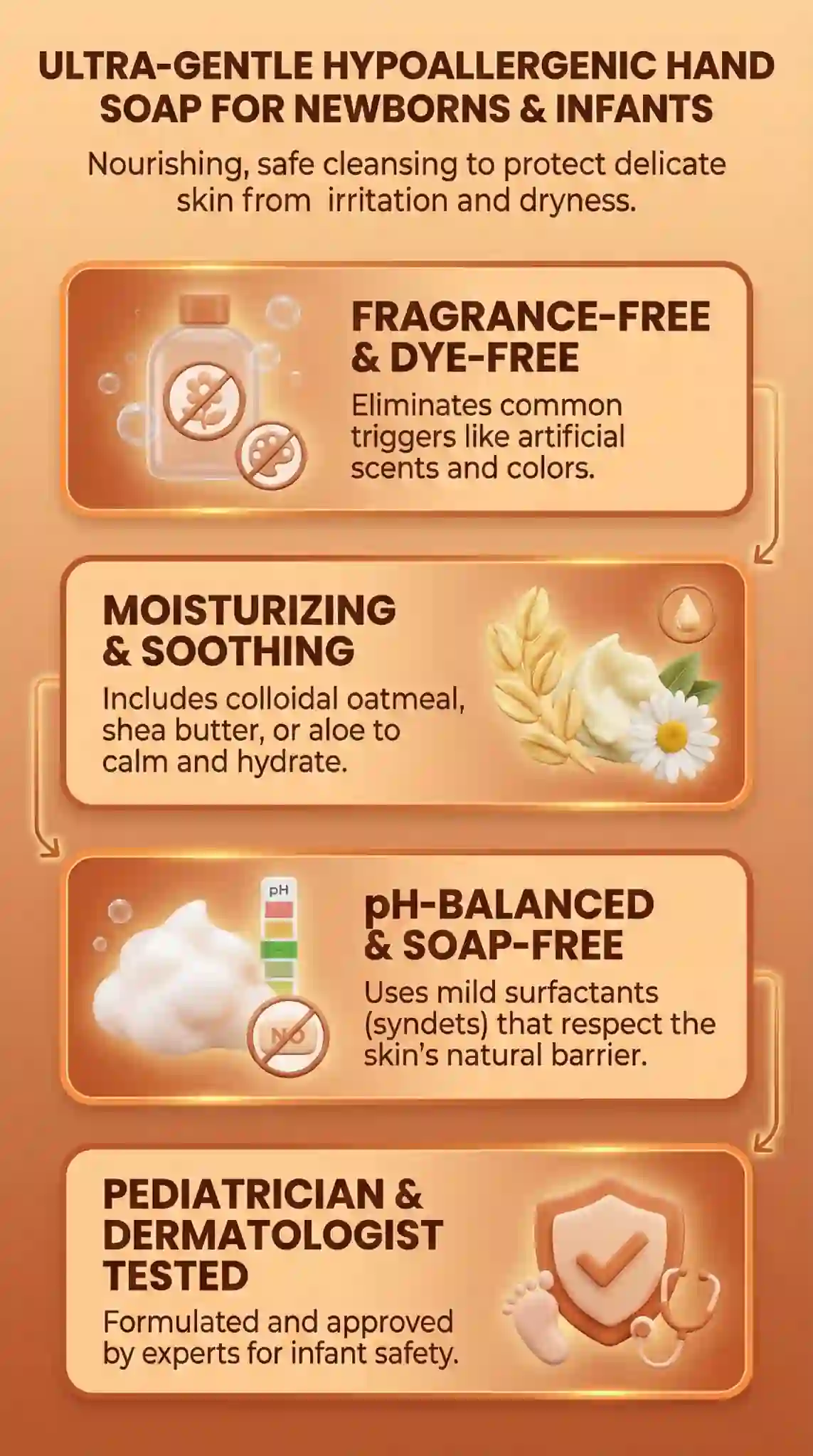
A hand soap safe for newborn caregivers must be:
Fragrance-free — one "parfum" entry can hide dozens of undisclosed allergens
SLS-free — no surfactants leaving residue that transfers to infant skin on contact
Alcohol-free — compromises developing barrier function with every use
Paraben-free and dye-free — sensitizers with no functional benefit to anyone
pH-balanced between 4.5 and 5.5 — formulated for developing skin, not adult skin
Independently lab tested — verified by someone other than the brand selling it
What parenthood added to our clinical understanding:
Newborn skin absorbs more and defends less for up to two full years after birth
Every ingredient on a caregiver's hands transfers to developing skin dozens of times daily
The formula on caregiver hands is a baby product — whether parents think of it that way or not
When we built NOWATA, that last point was the one we couldn't stop thinking about. If an ingredient appeared on any sensitization watchlist, it was removed. No exceptions. No compromises.
Q: Is "hypoallergenic" hand soap actually safe for newborn and infant skin?
A: Not automatically. This distinction matters more in the newborn period than at any other time.
What most parents don't know before it's too late:
The FDA does not regulate "hypoallergenic" — any brand can use it without proof
"Newborn safe" and "baby gentle" carry the same regulatory weight — which is none
We trusted these labels for our own children — and our daughter's skin still reacted
What that experience changed about how we formulate:
We stopped reading front labels entirely
We evaluated every ingredient individually against sensitization research
We excluded anything on any known contact allergen list — regardless of concentration
We verified every efficacy claim through independent Swiss laboratory testing
The bottom line:
The label is a marketing decision
The ingredient list is the product
We learned that the hard way — so our customers don't have to
Q: Can the soap on my hands trigger eczema in my newborn?
A: Yes — and this is the connection we never made until we were living it ourselves.
What the science confirms:
Newborn skin barrier is structurally incomplete for up to two years after birth
60% of all eczema cases develop in the first year of life
Ingredients on caregiver hands make direct repeated contact with developing infant skin during every feed, diaper change, and skin-to-skin moment
What we witnessed as parents before we had answers:
We were washing our hands with products we believed were safe
We were holding our children dozens of times daily
Our children were reacting — and we kept looking everywhere except our own hand soap
What changed when we started asking the right question:
We eliminated every known irritant from our formula
We eliminated the wet-dry cycle with waterless clumping technology
We independently verified 99.9% germ removal with nothing left behind on skin
The question isn't just what you put on your baby. It's what you put on your hands before you touch them. That shift in thinking is what NOWATA was built on.
Q: Is waterless hand soap effective enough to use around newborns where germ protection is critical?
A: As healthcare professionals, this was the question we asked ourselves before anyone else could. Gentle meant nothing to us if it didn't also mean clean.
What independent Swiss laboratory testing using ASTM E1174 medical-grade protocols confirmed:
99.9% physical removal of bacteria including E. coli
99.9% physical removal of viruses including Murine Norovirus — a human norovirus surrogate
Complete germ removal with no water, rinsing, towels, or residue left on skin
Why physical removal matters most for newborn caregivers:
Sanitizers kill germs but leave dead residue and harsh chemicals on skin
That residue transfers directly to infant skin on contact
NOWATA's clumping technology lifts germs, dirt, and oil off entirely
Brush the clumps away — everything goes with them
Nothing left on caregiver skin means nothing left to transfer to newborn skin
We were not willing to choose between clean and gentle for our own children. NOWATA exists because that trade-off should never be necessary.
Q: How often should caregivers wash their hands when caring for a newborn — and how do they protect their own skin in the process?
A: We lived inside this question for the entire newborn period — washing constantly and watching our own skin deteriorate in the process.
What clinical guidance recommends for newborn caregivers:
Before and after every feeding
Before and after every diaper change
After outside exposure or contact with surfaces
Before skin-to-skin contact
What that frequency does to caregiver skin:
Strips natural oils with every wash-and-dry cycle
Progressively compromises the skin barrier over dozens of daily washes
Creates micro-fissures that harbor bacteria and increase transfer risk to infant skin
Raises hand eczema risk by 51% at just 8 to 10 washes per day — per NIH research
What we built into NOWATA specifically for this:
No water required — eliminates the wet-dry cycle entirely
No rinsing or towel drying — removes mechanical stress that compounds over daily washes
Zero SLS, alcohol, synthetic fragrances, or parabens
99.9% physical germ removal — nothing left behind on skin
The insight we couldn't find anywhere else:
Protecting caregiver skin in the newborn period is not a comfort issue
Intact caregiver skin is cleaner, safer, and transfers less to the most vulnerable skin in the room
We built NOWATA because both things needed to be true at the same time
Nothing on the shelf made that possible — so we built it ourselves