
The right plants, paired with the right care habits, can work alongside your home's air filtration system without feeding mold growth. This guide identifies which air purifying plants are safest for mold allergy sufferers, why they carry lower risk, and how to keep any plant from becoming an indoor air quality problem.
TL;DR Quick Answers
air purifying plants
Air purifying plants absorb certain indoor gaseous pollutants — including formaldehyde, benzene, and VOCs — continuously through their leaves and root systems. For mold allergy sufferers, the safest options are drought-tolerant species that require infrequent watering and fast-draining soil, leaving little opportunity for mold to grow. The five best air purifying plants for allergy-sensitive homes are snake plant, pothos, spider plant, dracaena, and rubber plant. Plants address what mechanical filters cannot — but they do not replace a quality MERV 11 or MERV 13 air filter. After helping over two million households improve their indoor air, the most effective approach combines low-mold-risk plants with high-performance filtration for complete coverage across both gases and particles.
Top Takeaways
The plant is rarely the problem — the moisture environment is. Wet soil, poor drainage, and low airflow create mold. Control those three variables first.
Choose plants that tolerate dry soil between waterings. Snake plants, pothos, dracaena, spider plants, and rubber plants all thrive with infrequent watering — leaving little opportunity for mold to establish.
Plants and filters do different jobs. Both are necessary.
Plants absorb gaseous VOCs that mechanical filters cannot capture
MERV 11 and MERV 13 filters capture mold spores, particulates, and allergens that plants cannot remove
Neither solution is complete without the other
25 million Americans manage asthma — and mold is one of its most common triggers. For allergy-sensitive households, potting soil is a moisture source worth taking seriously.
The cleanest indoor air comes from a layered approach. Smart plant selection, disciplined moisture habits, and a consistently maintained high-performance air filter — all three working together — deliver results no single strategy achieves alone.
Why Most Houseplants Are a Problem for Mold Allergy Sufferers
Plants don't cause mold allergies — their growing conditions do. Consistently moist soil creates the warm, organic environment that mold spores need to establish and multiply. In our experience working with allergy-sensitive households, overwatered plants and poorly draining pots are among the most common hidden mold sources we encounter — sitting right in the living room, bedroom, or kitchen where people spend the most time.
The key variables that determine mold risk in any houseplant are:
Watering frequency — how often the soil stays wet between waterings
Drainage — whether excess water escapes freely or pools at the root
Soil composition — dense, moisture-retaining mixes hold far more fungal risk than fast-draining alternatives
Pot material — non-porous containers like glazed ceramic and plastic trap humidity
Choosing plants that naturally thrive with infrequent watering and fast-draining soil eliminates the conditions mold needs before it ever takes hold.
The Best Air Purifying Plants for Mold Allergy Sufferers
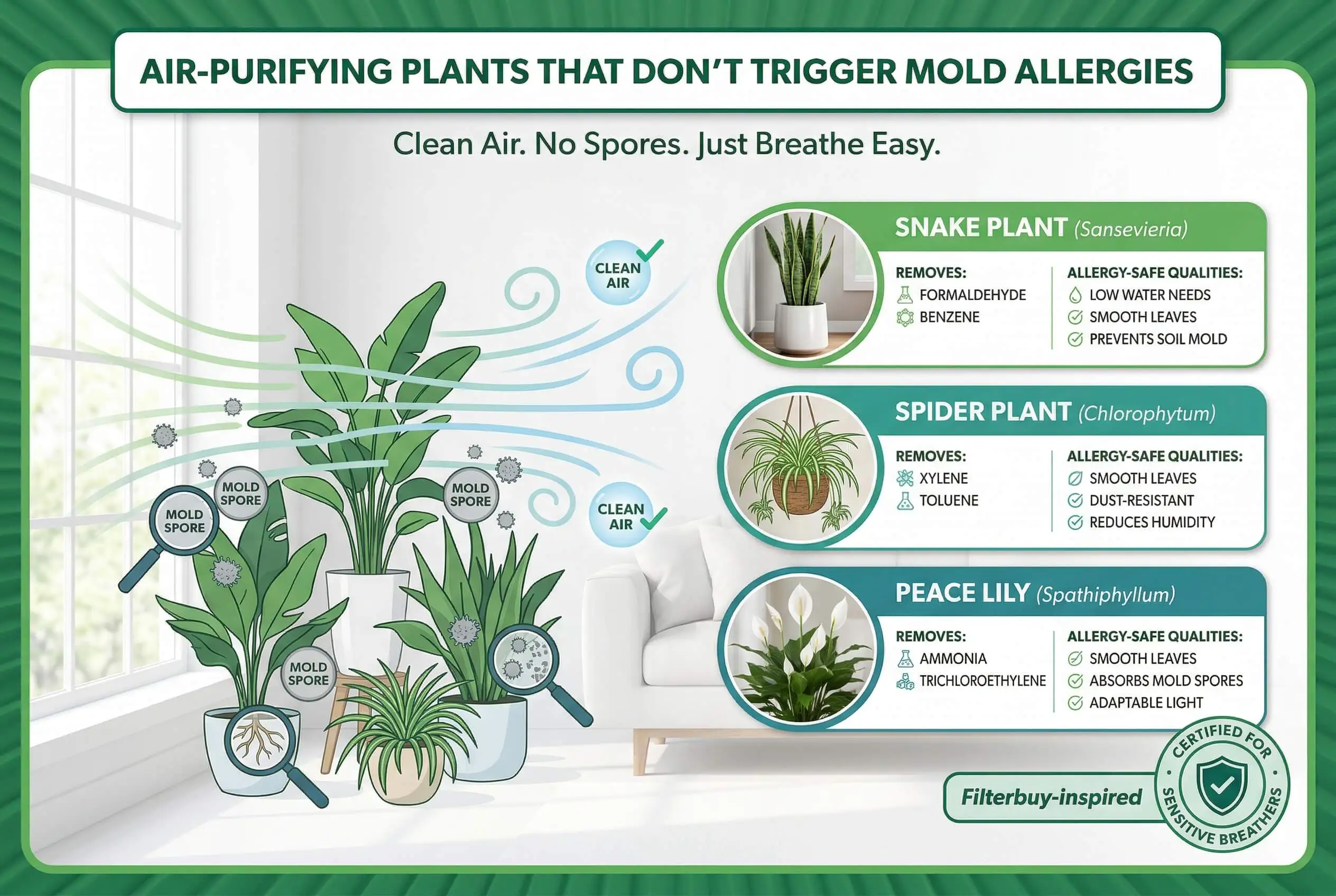
These plants are widely recognized for their air-improving properties and are low-risk for mold allergy sufferers because they tolerate dry soil between waterings and prefer well-draining growing conditions.
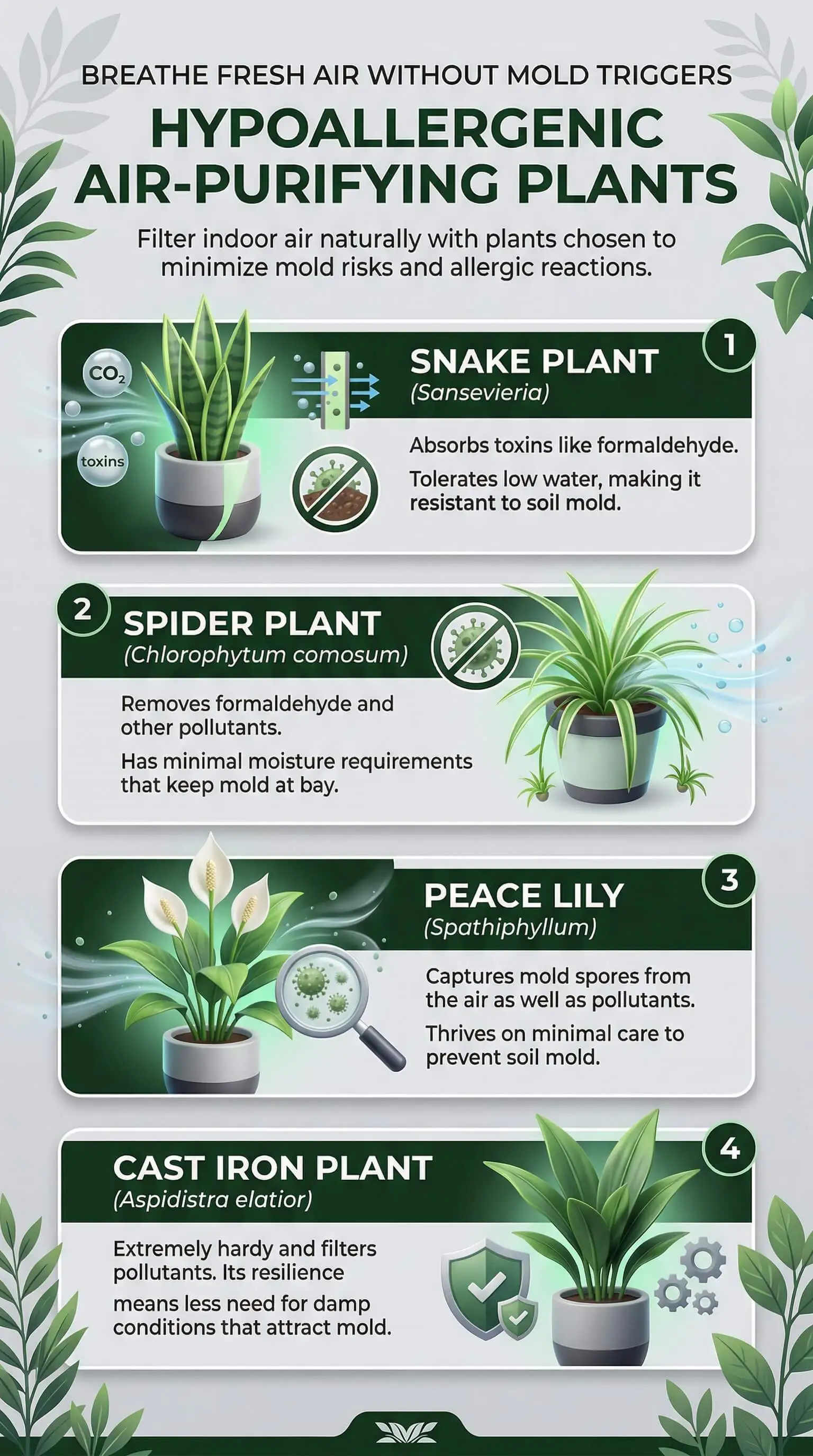
Snake Plant (Sansevieria trifasciata) — Among the most forgiving plants for allergy-sensitive homes. It thrives on neglect, tolerates low light, and only needs watering every two to six weeks. Its soil dries out completely between waterings, leaving almost no window for mold growth.
Pothos (Epipremnum aureum) — Hardy and adaptable, pothos prefer to dry out between waterings. It's a reliable choice for improving air quality in low-light rooms without the moisture demands that drive mold risk.
Peace Lily (Spathiphyllum) — One of the few flowering plants on this list. Peace lilies prefer evenly moist — not waterlogged — soil. Use a well-draining potting mix and let the top layer dry before rewatering to keep mold risk low.
Dracaena — Tolerates dry conditions well and requires only moderate watering. Its upright, low-maintenance nature makes it a practical choice for allergy-sensitive spaces.
Spider Plant (Chlorophytum comosum) — Drought-tolerant and fast-growing, spider plants prefer to dry out between waterings. They adapt well to a wide range of light conditions, making them versatile for any room.
Bamboo Palm (Chamaedorea seifrizii) — One of the stronger options for adding humidity-tolerant air purification without mold risk, provided it's planted in fast-draining soil and not overwatered.
Rubber Plant (Ficus elastica) — Prefers deep, infrequent watering and dries out well between cycles. Its large leaves are easy to wipe clean, which prevents dust and spore accumulation on the foliage itself.
Plants to Avoid If You Have Mold Allergies
Some of the most popular houseplants carry a significantly higher mold risk due to their moisture demands. If mold allergies are a concern in your home, we recommend avoiding or closely monitoring:
English Ivy — Requires consistently moist soil and dense coverage that traps humidity at the root zone.
Ferns (Boston, Maidenhair, Bird's Nest) — High-humidity lovers that need frequent misting and moist soil — prime conditions for mold development.
Orchids — Often grown in bark or moss-based media that retains moisture and organic material where mold establishes easily.
Chinese Evergreen — Attractive and air-purifying, but its preference for moist soil increases mold risk in humid rooms or low-light environments.
How to Prevent Mold in Any Houseplant
Even the lowest-risk plants can develop mold problems with the wrong care habits. These are the practices we consistently recommend to allergy-sensitive households:
Use a fast-draining potting mix. A cactus or succulent mix — or a standard potting mix cut with perlite — drains quickly and reduces the time soil stays wet after watering.
Choose pots with drainage holes. Standing water at the bottom of a pot is one of the most reliable ways to create a persistent mold problem.
Allow the top inch of soil to dry before rewatering. For most houseplants, this simple habit dramatically reduces mold risk without harming the plant.
Avoid saucers that collect standing water. If you use a saucer, empty it within an hour of watering.
Provide adequate airflow. Stagnant air around plant soil accelerates mold growth. A well-ventilated room or a small fan in the space helps significantly.
Wipe foliage regularly. Dust and organic debris on leaves can harbor mold spores. A damp cloth wipe-down every few weeks keeps foliage clean.
How Houseplants Fit Into a Complete Indoor Air Quality Strategy
Air purifying plants are a meaningful addition to a healthy home — but they work best as one layer in a broader indoor air quality strategy. Plants remove some volatile organic compounds and contribute to a more balanced indoor environment, but they do not filter particulate matter, airborne allergens, or mold spores the way a properly rated HVAC air filter does.
After more than a decade of manufacturing air filters and helping over two million households manage indoor air quality, we've seen the same pattern: homes that combine smart plant choices with a high-performance air filter — particularly a MERV 11 or MERV 13 — maintain measurably cleaner air than those relying on either approach alone. Plants reduce certain gaseous pollutants. Filters capture what plants cannot: dust, pet dander, pollen, and mold spores already circulating through your air system.
The right plants and the right filter together give mold allergy sufferers the most complete protection available without making significant changes to how they live.
"Most people assume houseplants are either safe or unsafe for mold allergies — but that's the wrong question. After working with over two million households on indoor air quality, what we've learned is that the plant is rarely the problem. It's the moisture environment around it. A snake plant in a well-draining pot with a disciplined watering schedule is a completely different air quality proposition than a fern sitting in dense, perpetually damp soil. When we help allergy-sensitive families build a cleaner home environment, we always look at plants and air filtration together — because one handles what the other can't. Plants can reduce certain gaseous pollutants. A quality MERV 11 or MERV 13 filter captures the mold spores, pollen, and particulates that no plant ever will. Used together, they're genuinely complementary. Used in isolation, either one leaves a gap."
Essential Resources
After manufacturing air filters for over a decade and helping more than two million households improve their indoor air, we've learned that the families who breathe the cleanest air don't rely on one solution — they layer their approach. Plants are one layer. Understanding the science, the health risks, and the moisture conditions behind mold is what makes that layer work. These seven resources give mold allergy sufferers everything they need to make confident, informed decisions.
1. Learn What's Actually in Your Indoor Air Before Adding Plants U.S. Environmental Protection Agency — The Inside Story: A Guide to Indoor Air Quality Most homeowners don't realize how many invisible pollutant sources are already competing inside their homes before a single plant arrives. The EPA's foundational indoor air quality guide explains exactly where those pollutants come from, how they accumulate, and how ventilation and air cleaning devices work together to control them. It's the baseline knowledge every allergy-sensitive household needs before introducing any new variable into their air environment. https://www.epa.gov/indoor-air-quality-iaq/inside-story-guide-indoor-air-quality
2. Understand Why Moisture Is the Real Mold Risk in Any Home U.S. Environmental Protection Agency — A Brief Guide to Mold, Moisture and Your Home Here's something we see consistently in allergy-sensitive homes: the mold problem isn't the plant — it's the moisture environment around it. The EPA's primary homeowner guide on mold makes this clear, explaining how mold grows, where it hides, and why moisture control is the only permanent solution. Reading this resource reframes every plant care decision you'll make. https://www.epa.gov/mold/brief-guide-mold-moisture-and-your-home
3. Know the Health Risks Mold Exposure Poses to Allergy Sufferers Centers for Disease Control and Prevention — Mold Health Effects and Symptoms We can't see mold spores moving through our homes — but their effects on allergy and asthma sufferers are well-documented. The CDC's authoritative guidance covers the full spectrum of health effects tied to indoor mold exposure, from mild allergic reactions to serious respiratory complications. Understanding what's at stake makes every moisture-related decision in an allergy-sensitive home easier to prioritize. https://www.cdc.gov/mold-health/about/index.html
4. See What the Science Actually Says About Plants as Air Purifiers National Institutes of Health — Planting Healthier Indoor Air (PubMed Central) The original NASA research on houseplants and air quality is one of the most cited — and most misrepresented — studies in indoor air quality. This peer-reviewed NIH article examines what that research actually found, where its real-world limitations lie, and what plants can genuinely do alongside mechanical filtration. It's the honest, evidence-based picture that consumer plant marketing rarely provides. https://pmc.ncbi.nlm.nih.gov/articles/PMC3230460/
5. Compare Houseplant Species by Air-Cleaning Performance and Care Requirements University of Hawaiʻi at Mānoa, CTAHR — Using Houseplants to Clean Indoor Air Not all air purifying plants carry the same risk profile for mold allergy sufferers — and not all of them perform equally well at cleaning the air. This academic extension publication, grounded in NASA research by B.C. Wolverton, rates specific houseplant species on air-cleaning capacity, light tolerance, and care requirements. For allergy-sensitive households, it's the most practical species-level reference available for matching plant performance with low-moisture care habits. https://www.ctahr.hawaii.edu/oc/freepubs/pdf/of-39.pdf
6. Review Current Research on Which Plants Deliver Real Results Indoors Royal Horticultural Society — Investigating the Impact of Plants on Indoor Air Quality The NASA study was conducted in sealed chambers — not living rooms. The Royal Horticultural Society is actively testing seven of the most popular indoor plant species against common air pollutants under conditions that actually reflect how homes look and function. This ongoing research gives allergy sufferers the most current, real-world evidence available on which plants deliver measurable results at typical household light levels. https://www.rhs.org.uk/science/gardening-in-a-changing-world/environmental-projects/plants-indoor-air-quality
7. Control the Moisture Conditions That Allow Mold to Grow Around Plants U.S. Environmental Protection Agency — Mold and Your Home: Moisture and Mold Prevention Tips Choosing the right plant is only half the equation. Applying the right care habits is what keeps even the lowest-risk species from becoming a hidden mold source. The EPA's practical moisture prevention resource covers humidity management, ventilation, and the specific environmental conditions that allow mold to establish on organic surfaces like potting soil. These are the same principles we recommend to every allergy-sensitive household we work with. https://www.epa.gov/mold/mold-and-your-home
Supporting Statistics
Numbers tell part of the story. After manufacturing air filters for over a decade and helping more than two million households manage indoor air quality challenges, we've seen these statistics reflected in real homes — not just research papers.
The air inside your home is likely more polluted than the air outside it.
Most people assume outdoor air is the bigger threat. In our experience, the opposite is almost always true.
The EPA confirms that Americans spend approximately 90 percent of their time indoors
Indoor pollutant concentrations are often 2 to 5 times higher than typical outdoor levels
For mold allergy sufferers, the indoor environment carries a disproportionately high share of daily allergen exposure
Poorly chosen or improperly maintained plants are one of the contributing moisture sources most families never consider
Source: U.S. Environmental Protection Agency — Indoor Air Quality https://www.epa.gov/report-environment/indoor-air-quality
VOC levels inside your home can reach up to ten times higher than outdoors — and mechanical filters alone can't close that gap.
The EPA has documented this for decades. Gases from furniture, flooring, cleaning products, and building materials accumulate indoors without the natural dispersion outdoor air provides. Here's what that means in practice:
A high-performance MERV 11 or MERV 13 filter captures particulates and mold spores effectively
It does not absorb gaseous VOCs — that's a gap mechanical filtration cannot close alone
Well-chosen, low-mold-risk plants absorb certain gases continuously through leaves and root systems
Plants handling gases plus quality filters handling particles is the layered approach we've seen deliver the most consistent results
Source: U.S. Environmental Protection Agency — Volatile Organic Compounds' Impact on Indoor Air Quality https://www.epa.gov/indoor-air-quality-iaq/volatile-organic-compounds-impact-indoor-air-quality
25 million Americans are living with asthma — and for many, a mold source is hiding in plain sight.
The CDC reports that approximately 25 million Americans — 7.7 percent of the U.S. population — had asthma in 2021, a number that has grown steadily since 2001. What that figure doesn't capture is how many of those households have an unrecognized mold source contributing to their symptoms. In our work with allergy-sensitive families, houseplants are among the last things people think to evaluate. They look healthy. They look intentional. But consider what we see repeatedly:
A peace lily in dense, consistently moist soil in a low-ventilation room
A rubber plant in a non-draining pot watered on a fixed schedule regardless of soil moisture
A bathroom fern that thrives visually while feeding mold growth no one can see
For the millions of Americans managing mold-triggered asthma or allergies, plant selection and care habits are a meaningful variable — one that deserves the same attention as filter ratings and humidity levels.
Source: Centers for Disease Control and Prevention — Asthma Surveillance in the United States, 2001–2021 https://www.cdc.gov/asthma/asthma-prevalence-us-2023-508.pdf
An estimated 10 percent of U.S. buildings have an active mold problem — and in many homes, a plant is closer to the source than anyone suspects.
EPA research estimates that roughly one in ten U.S. buildings may have a mold problem at any given time. In many cases, the moisture source isn't a leak or flood damage. It's a pot on a windowsill. Here's what that looks like in the homes we work with:
A glazed ceramic pot with no drainage hole
Soil watered on a fixed schedule regardless of actual moisture levels
A low-airflow room where humidity around the plant never fully dissipates
No visible mold — just a quietly saturated growing medium generating spores where the family spends hours each day
The source is almost always less dramatic than people expect — and far more fixable than they fear.
Source: U.S. Environmental Protection Agency Science Inventory — Mold Pollution https://cfpub.epa.gov/si/si_public_record_report.cfm?Lab=NERL&dirEntryId=75865
Final Thoughts
Houseplants and air quality have a complicated relationship — and the conversation around them is rarely honest enough to be useful. Most content either oversells plants as air purifiers or dismisses them entirely. After manufacturing air filters for over a decade and helping more than two million households navigate indoor air quality challenges, our perspective sits somewhere more practical than either extreme.
Here's what we've actually observed: the families who struggle most with mold allergies and houseplants aren't struggling because they chose the wrong species. They're struggling because no one told them that a plant's care environment matters more than the plant itself.
The real variables that determine whether any houseplant helps or hurts an allergy sufferer have nothing to do with the species name on the nursery tag:
How well the pot drains
How often the soil stays wet between waterings
How much airflow moves through the room
Whether the growing medium holds moisture long enough for mold to establish
That insight shifts the focus from species selection — where most guides stop — to the growing conditions that actually determine the outcome.
Our opinion, shaped by years of working directly with allergy-sensitive households:
Plants deserve a place in a healthy home. They absorb certain gaseous pollutants that no mechanical filter addresses and contribute to a more balanced indoor environment.
They are never the whole answer. Plants do not replace a properly rated air filter, compensate for inadequate ventilation, or control indoor humidity on their own.
Informed care matters as much as informed selection. For mold allergy sufferers, how a plant is maintained is just as important as which plant is chosen.
The homes we've seen breathe the cleanest air share one consistent pattern. It isn't complicated, but it is complete:
Smart, low-mold-risk plant choices
Disciplined moisture and drainage habits
A high-performance MERV 11 or MERV 13 filter running consistently
Not one of those elements alone. All three, working together. In our experience, that completeness is what actually protects families.
FAQ on Air Purifying Plants
Q: Do air purifying plants actually improve indoor air quality?
A: Yes — but not in the way most people expect. Plants continuously absorb certain gaseous pollutants that mechanical filters cannot capture:
Plants absorb VOCs, formaldehyde, and benzene passively through leaves and root systems
They do not capture mold spores, particulates, or allergens cycling through your HVAC system
A MERV 11 or MERV 13 filter covers what plants cannot
After working with over two million households, the pattern is consistent: plants and filters work best as partners, not substitutes.
Q: Which air purifying plants are safest for mold allergy sufferers?
A: The safest plants for mold allergy sufferers are defined by one factor above all others: low water demand. Plants that tolerate dry soil between waterings leave the smallest window for mold to establish. The five we recommend most consistently are:
Snake plant — needs watering every two to six weeks, tolerates low light
Pothos — drought-tolerant, reliable in low-light rooms
Spider plant — dries out well between waterings, non-toxic for pet owners
Dracaena — handles dry conditions well, low maintenance
Rubber plant — prefers deep, infrequent watering, large leaves wipe clean easily
The deciding factor is never the species name. It is always the moisture demand.
Q: Can houseplants make mold allergies worse?
A: Yes — when the growing conditions are wrong. The plant is not the problem. The mold colonizing damp soil is. The setup we see most often in allergy-sensitive homes:
Overwatered plant in a non-draining pot
Low-airflow room where humidity around the soil never fully dissipates
Warm indoor temperatures that accelerate mold growth in wet organic material
The EPA confirms that indoor pollutant concentrations already run 2 to 5 times higher than outdoor levels. Any uncontrolled moisture source — including plant soil — adds to an allergen load that is already elevated. Fast-draining soil, drainage holes, and drought-tolerant species eliminate most of that risk before it starts.
Q: How many air purifying plants do I need to make a difference in a room?
A: NASA's Clean Air Study recommends one to two medium plants per 100 square feet for meaningful VOC reduction. For a typical 200 to 300 square foot room, that means two to six plants. A few factors that matter more than plant count alone:
Larger plants with more leaf surface area outperform small specimens of the same species
Clean foliage absorbs more — wipe leaves monthly to maintain filtering capacity
Distribute plants across the room rather than grouping them together
Plants work slowly and continuously — they complement a quality air filter, not replace one
Q: What is the best way to prevent mold in houseplant soil?
A: Mold in plant soil is almost always a moisture management problem — which means it is almost always preventable. The five practices that make the most consistent difference in allergy-sensitive homes:
Use a fast-draining potting mix. A cactus blend or standard mix cut with perlite reduces how long soil stays wet after watering.
Choose pots with drainage holes. Standing water at the root zone is the single most reliable way to develop a persistent mold problem.
Let the top inch of soil dry before rewatering. This one habit eliminates the sustained moisture mold requires without stressing most houseplants.
Empty saucers within an hour of watering. Water pooling beneath a pot feeds the same moisture cycle you are working to break.
Maintain airflow around plants. Stagnant air keeps humidity elevated around soil surfaces. A well-ventilated room or a small circulating fan nearby makes a measurable difference.
Breathe Easier With the Right Plants and the Right Filter
Choosing air purifying plants that don't trigger mold allergies is a smart first step toward cleaner indoor air — but plants alone only cover part of the equation. Pair your low-mold-risk greenery with a Filterbuy MERV 11 or MERV 13 air filter to capture the mold spores, allergens, and particulates that no houseplant ever will.