
TL;DR Quick Answers
chicago air quality
Chicago's air quality shifts through the day with wind off Lake Michigan, traffic, and seasonal ozone. Cook County has earned failing marks for ozone and particle pollution in recent years. Checking the live index before heading out matters, but sealed-up winters trap pollutants indoors too, so your home's air needs its own protection.
Check today's index. Chicago's air quality can swing hourly with wind, traffic, and ozone levels, so check the current reading before you head out or decide whether to open the windows.
Know the trend. Cook County has received failing grades for both ozone and particle pollution in recent years, according to the American Lung Association's State of the Air report.
Protect indoors too. Outdoor conditions only tell half the story. Chicago's sealed-up winters and humid summers trap pollutants inside homes for months at a stretch.
Filter accordingly. A properly sized, high-MERV air filter reduces what recirculates indoors no matter what the outdoor index says on a given day.
Top Takeaways
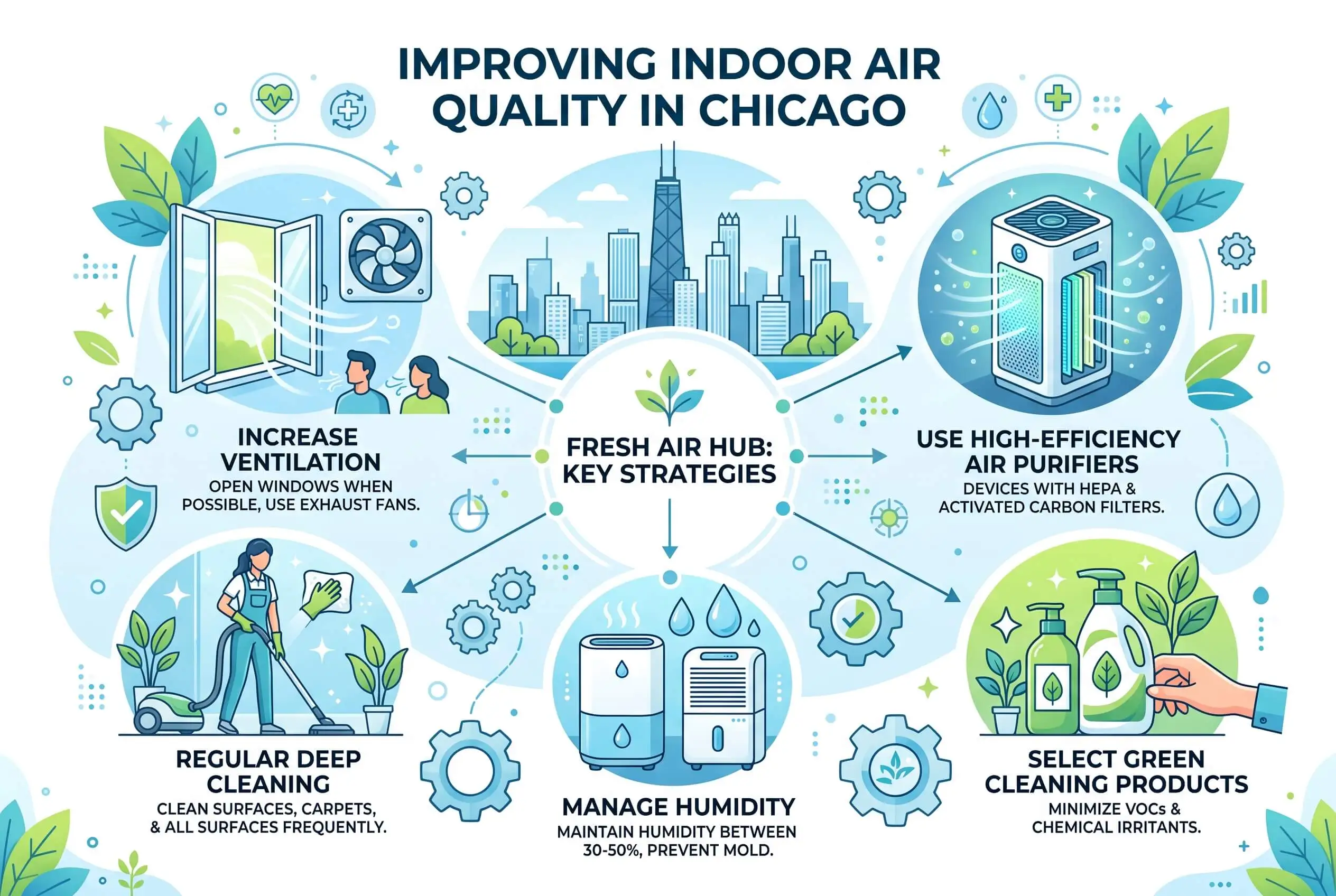
Ventilate on purpose. Run exhaust fans and crack windows after cooking, showering, or cleaning.
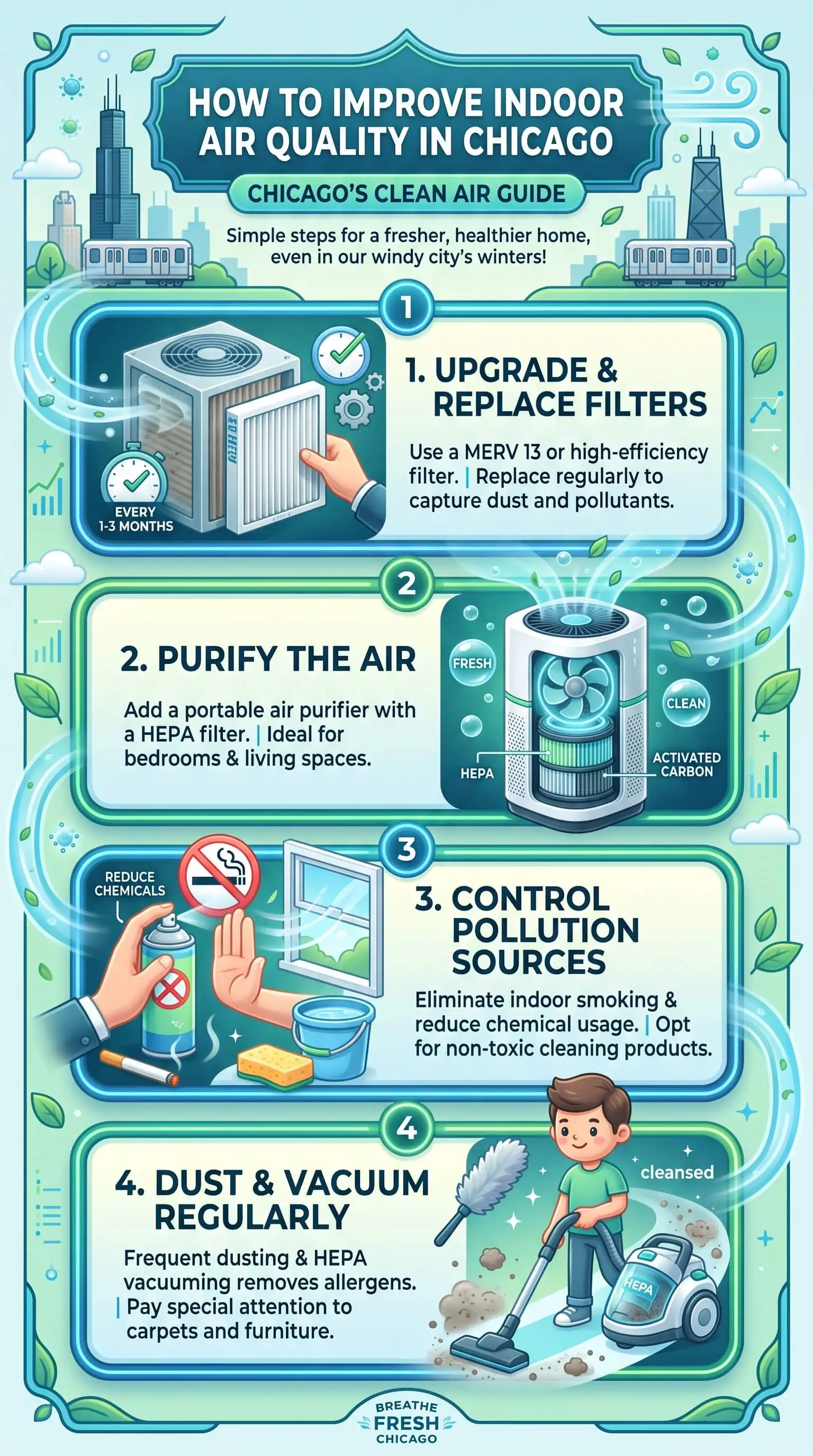
Filter consistently. A MERV 8 to 13 furnace filter, changed every one to three months, does more than most gadgets.
Control humidity. Stay between 30 and 50 percent to discourage mold and dust mites.
Cut sources first. Fewer scented products and sealed-up chemicals mean less for your filter to catch.
Check outdoor conditions. Knowing the current air quality index helps you decide when to open windows versus run filtration indoors.
Chicago's weather does the opposite of what indoor air wants. Lake Michigan pushes brutal cold through the city each winter and heavy humidity each summer, a swing that Wikipedia's overview of Chicago captures well. Homeowners respond by sealing up tight for months at a stretch, which means whatever pollutants get generated inside just stay there. Fixing that takes two things working together: fewer sources of pollution, and a house that actually moves air through it.
Ventilation handles the air-movement half of that equation. Crack a window for ten minutes after cooking or showering, and you clear out cooking particles and bathroom moisture before they settle into carpet and drywall. A bathroom or kitchen exhaust fan that vents outdoors, rather than one that just recirculates air back into the room, does that job automatically every time you cook or bathe.
Filtration catches what ventilation misses. I run a furnace filter with a MERV rating between 8 and 13, and I swap it every one to three months instead of waiting until it looks dirty. I felt the difference in my own apartment within a week of putting that filter on an actual schedule.
Humidity needs its own line of defense. Chicago summers push indoor humidity past what's healthy, and keeping it between 30 and 50 percent discourages dust mites and mold without drying out your sinuses. A basic hygrometer tells you exactly where you stand, so you're not guessing.
Source control comes before any of that. Fewer scented candles, cleaning chemicals stored in a sealed cabinet, and water leaks fixed within a day or two all mean less pollution for your ventilation and filtration to clean up in the first place.
None of that tells you what's happening outside your walls on a given day. That's where checking Chicago's current live air quality index earns its place in the routine. It tells you whether today is a window-open day or a filter-only day.
"In my experience, a MERV-rated furnace filter swapped on schedule beats any gadget I've tried."
7 Essential Resources
Learn What's Actually Causing Your Indoor Air Problems
The EPA's home guide to reducing indoor pollutant sources, ventilation gaps, and radon.
Check Whether Mold Is Behind Your Symptoms
The CDC's guidance on mold health effects and how to reduce exposure at home.
See How New-Home Ventilation Standards Apply to Older Houses Too
Track Illinois' Air Pollution Action Days
Illinois EPA's outdoor air forecasts and Air Pollution Action Day alerts for the Chicago area.
Explore Chicago's Own Air Sensor Network
The City of Chicago's Open Air Chicago project and its citywide particulate and NO2 monitoring.
Read the Federal Guide Every Homeowner Should Have Read By Now
The CPSC and EPA's joint guide to indoor air pollutant sources, room by room.
Get a Room-by-Room Plan for Allergy Season
The Asthma and Allergy Foundation of America's steps for controlling indoor allergens and humidity.
3 Statistics
Cook County, Illinois earned an F grade for ozone pollution in 2025, with the Chicago-Naperville metro area ranking 15th worst in the nation for unhealthy ozone days and 13th worst for year-round particle pollution.
The federal Air Quality Index runs on a scale where a value of 50 or below signals good air quality and a value above 300 signals hazardous conditions, across six color-coded categories.
More than 25 million people in the United States have asthma, including 4.7 million children, a population especially sensitive to indoor air triggers.
These statistics highlight why improving indoor air matters just as much as monitoring outdoor conditions in Chicago, and why air purifiers can play an important role in reducing indoor airborne particles when pollution levels are elevated.
Final Thoughts and Opinion
None of this requires a renovation. Consistency changed my own air quality: I run the exhaust fan every time now instead of just when I remember, and the filter swap lives on a calendar instead of waiting until it looks dirty. Chicago's weather will keep pushing homes toward being sealed up tight for large stretches of the year. That's exactly why the ventilation and filtration habits above matter more here than they would somewhere with milder seasons.
Frequently Asked Questions
How quickly can indoor air quality actually improve?
Ventilation changes show up almost immediately. Filtration and humidity control usually take a week or two of consistent use before the difference becomes noticeable.
Do houseplants meaningfully improve indoor air quality?
Not by themselves. A reasonable number of houseplants make a room feel better but don't remove a meaningful amount of pollutants on their own, so they work best alongside ventilation and filtration, not instead of them.
What MERV rating is right for a Chicago home?
MERV 8 to 11 handles dust and pollen well for most households. MERV 13 adds finer particle capture, which helps during high-pollen stretches or when local particle pollution is elevated, as long as your HVAC system is rated to handle the added airflow resistance.
Is it worth checking the air quality index before opening windows?
Yes. On days when the outdoor index is elevated, keeping windows closed and relying on indoor filtration protects your air better than ventilating with outside air that's currently part of the problem.
CTA
Improving the air inside a Chicago home comes down to a handful of habits, repeated consistently, rather than one big purchase. Start with whichever step fits your routine now, then layer in the rest over the next few weeks. Adding a quality air filter to your HVAC system or air purifier can make those everyday habits even more effective by helping capture airborne particles before they circulate throughout your home.