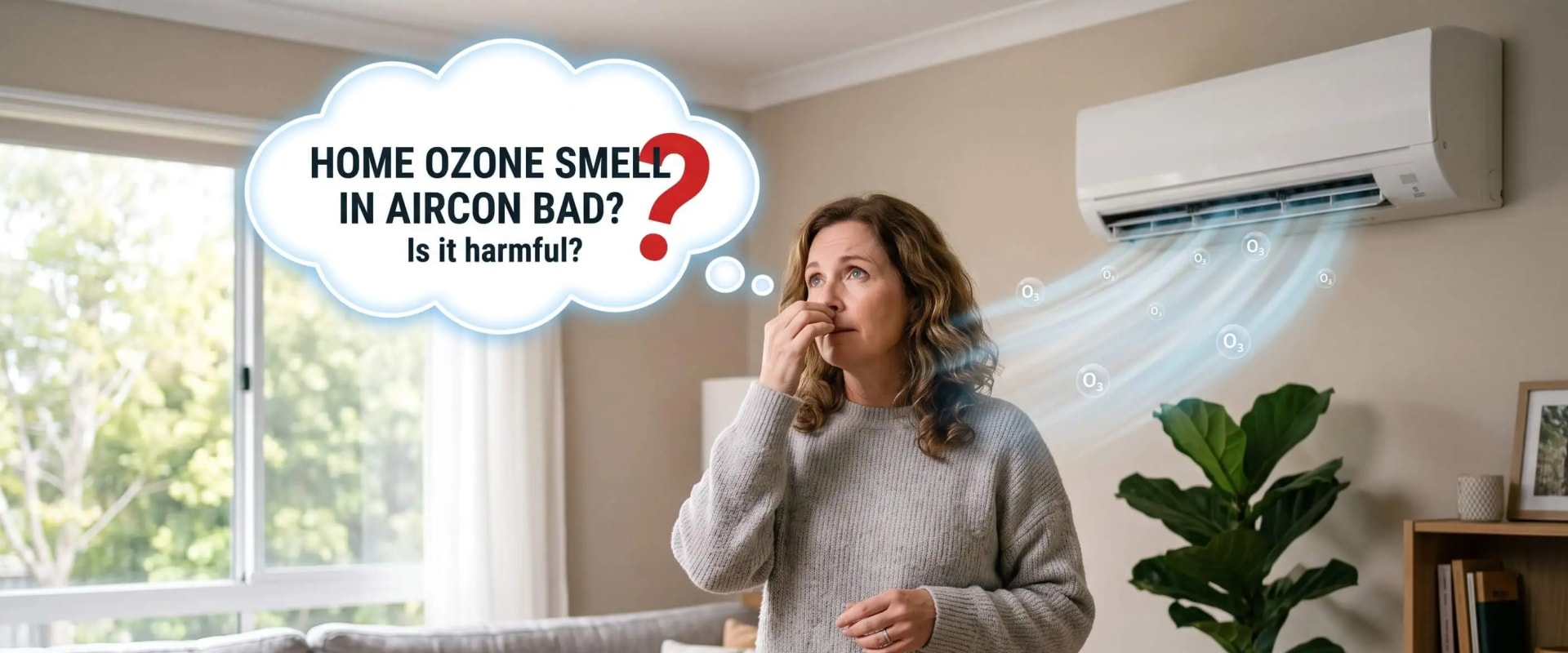
Your nose is the only ozone detector in your house, and it works. That sharp metallic smell, the one most people compare to bleach, is one of the few air quality problems you can catch without a meter or a service call. Most of what moves through a home gives you nothing to work with at all. So what does ozone smell like matters far less than where you happen to be smelling it.
I learned the second half of that the hard way. One Saturday morning I walked past the washer, caught the clean-edged scent you get right before a thunderstorm breaks, decided a box of dryer sheets had tipped over, and went back to work. Two hours later the outlet plate above the folding counter was warm under my hand. Outdoors after lightning, that same smell is harmless weather. Behind drywall, it can be a fire getting a head start.
TL;DR Quick Answers
What does ozone smell like?
Sharp and metallic, closest to chlorine or bleach, with the electric edge you catch during a thunderstorm. Most people recognize it instantly. What matters more is location. Outdoors after lightning it is harmless weather. Indoors, that same smell is usually your house reporting something, and near wiring it can mean arcing.
Closest comparisons: chlorine, bleach, hot metal, the air during a lightning storm.
Often confused with: petrichor, the earthy smell after rain, which soil bacteria produce and rain releases.
When it is harmless: outdoors after a storm, or on a hot afternoon with the windows open.
When to act immediately: near an outlet, switch, or appliance, which points to electrical arcing.
One catch worth knowing: ozone blunts your sense of smell at higher concentrations, so a fading smell does not prove the source is gone.
Top Takeaways
Two versions cannot wait. Sulfur means leave the house and call. Sharp ozone near wiring means cutting that circuit and calling an electrician.
The rest are low stakes. An ionizer left running, a printer boxed into a closet, or outdoor air on a hot afternoon.
Removing the source beats cleaning the air. Ozone is a gas, and a particle filter is built for particles.
Give it an hour. Ozone converts back to oxygen once the source stops, and fans with open windows speed that up.
A fading smell proves nothing. Ozone blunts your ability to detect it, so keep the air moving and keep looking.
What Does Ozone Smell Like, and Why Location Matters More
Breathable oxygen travels as two atoms bonded together. Ozone carries a third. That extra atom leaves the molecule unstable and quick to react with whatever it touches, and your nose is picking up the reaction rather than the gas itself. Energy makes it. Lightning, a sparking motor, a high-voltage lamp, sunlight working on traffic exhaust: wherever enough energy splits oxygen apart, ozone shows up. Which makes the smell a report on your house instead of an odor in its own right.
One correction worth making, because nearly everyone has this backwards. The earthy smell that arrives after rain is petrichor, and it comes from soil bacteria. Ozone is the sharp electric edge you catch during the storm itself, while the lightning is still working.
To settle the identification before you touch anything, what does ozone smell like compared with similar household odors sets the candidates beside each other. Burning plastic, mustiness, dirty sock syndrome, gas. That comparison drives everything that follows.
Rule Out the Two Emergencies First
Rotten eggs or sulfur. This one is not ozone at all. Natural gas carries an added odorant that smells like sulfur, so treat it as a leak. Leave the house first, then call your gas utility or 911.
Sharp ozone or hot plastic near an outlet, switch, fixture, or appliance. This points to electrical arcing. Overheating or sparking wiring splits oxygen as it discharges, which is how an electrical smell and a chlorine smell end up being the same event.
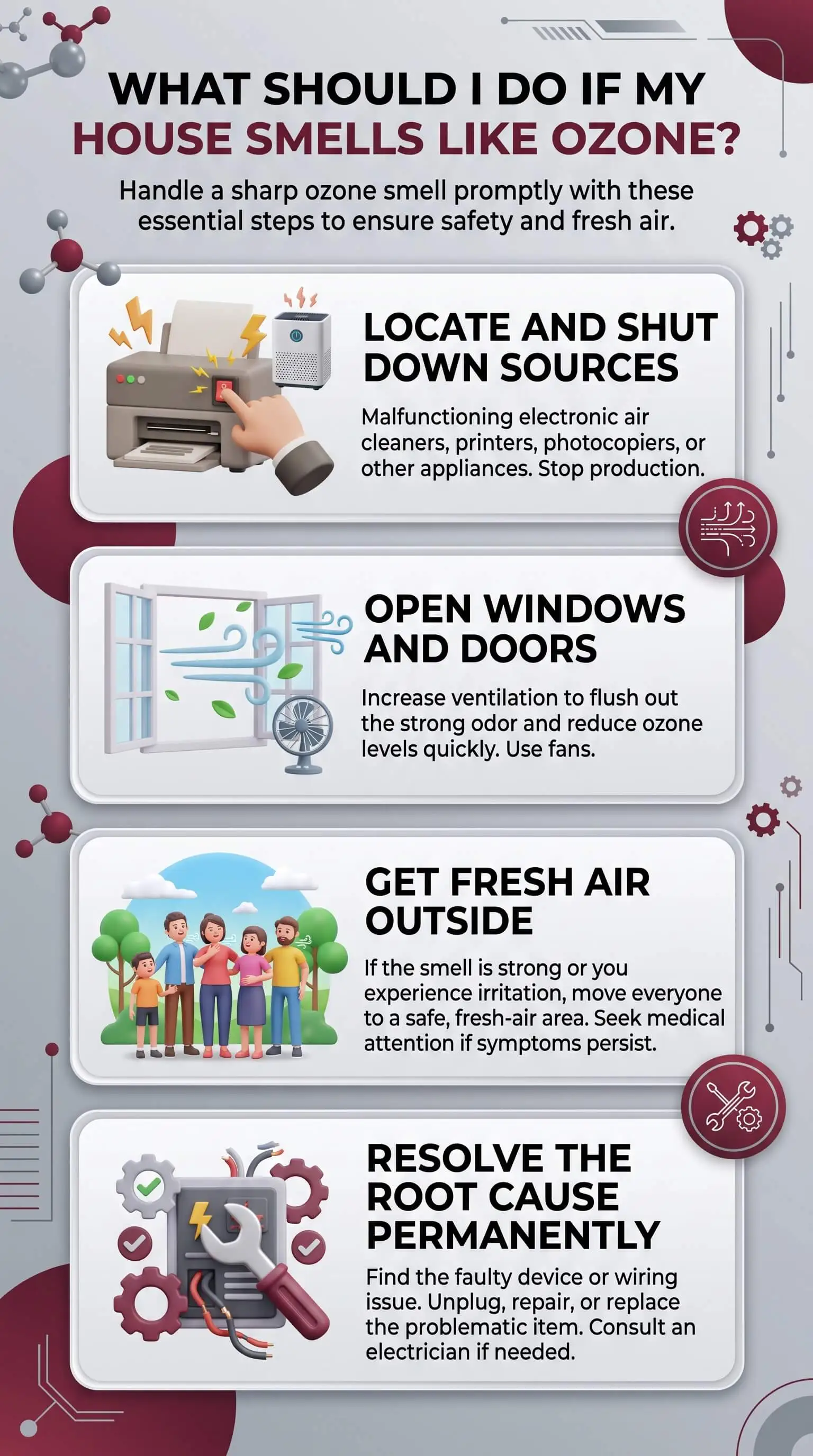
Arcing signs travel together. Listen for a faint buzz. Then look for a warm or discolored outlet plate, scorch marks around the receptacle, lights that flicker on one circuit and nowhere else. My laundry room had two of those and I walked past both. Cut power at the breaker, stop using anything on that circuit, and get a licensed electrician in before it goes back on.
Shut Down the Likely Source
With the emergencies cleared, match what you noticed against the likeliest cause.
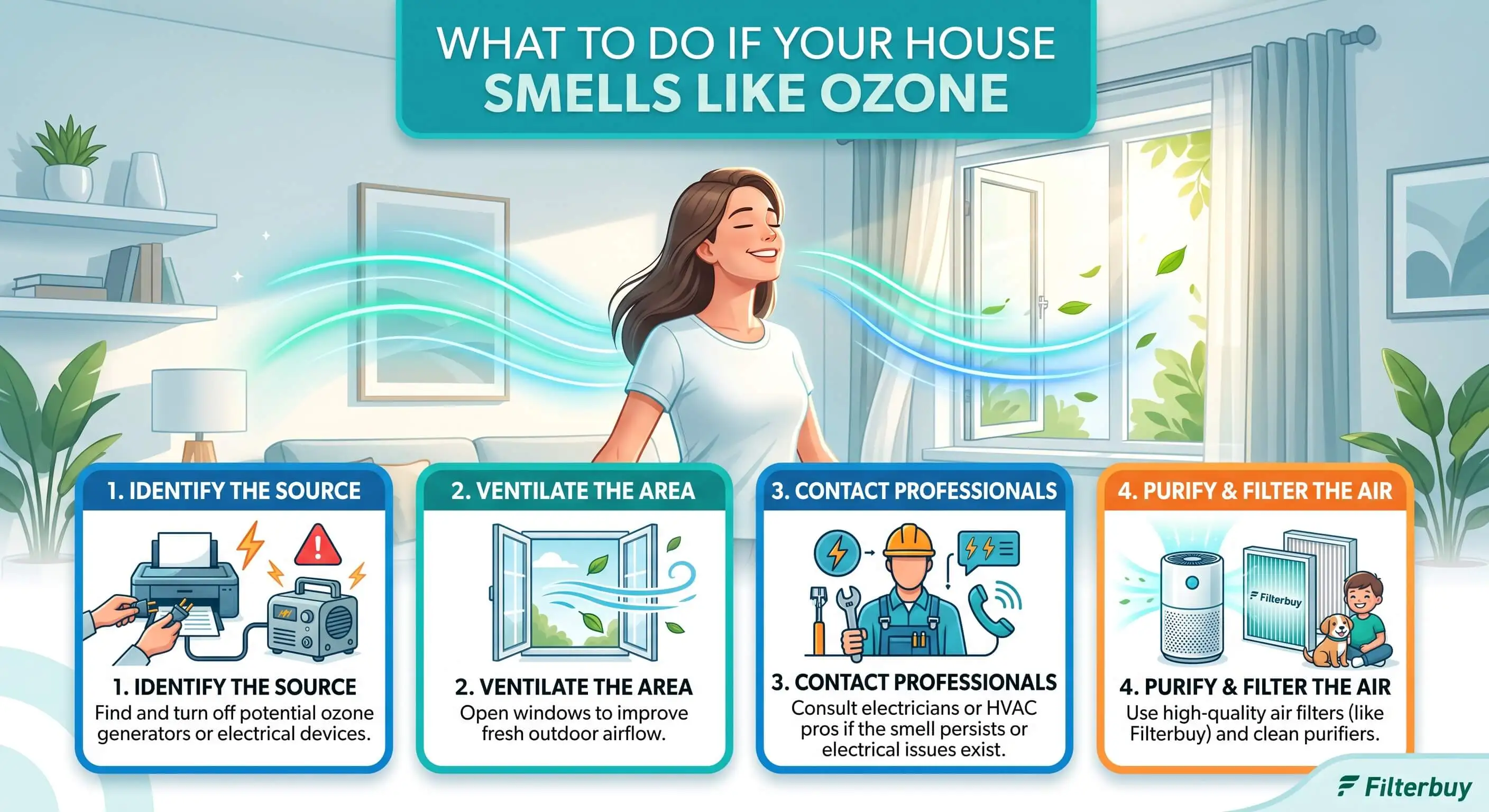
An ionizer or ozone generator running nearby. Some make ozone on purpose. Others produce it as a side effect of charging particles. Unplug it, and read how ionizing purifiers generate ozone if one of these runs in a bedroom.
The smell arrives when the HVAC system starts. Certain UV-C lamps inside air handlers emit ozone. Any electrical symptom in that equipment means shutting the system down and calling a technician.
A laser printer in a small closed room. Open the door and move the machine somewhere with air.
Hot sunny afternoons, worse with the windows open. Outdoor ozone is drifting in. Close the house through the afternoon peak.
Every one of those fixes comes down to switching something off or opening something up. Filtering appears nowhere on the list, for a reason I get to below.
Ventilate and Give It Time
Ozone falls apart on its own. Once the source stops it converts back into ordinary oxygen, and open windows with a fan moving air will clear most rooms inside an hour. A smell that outlasts that, or clears and then returns, means something is still making it.
Now the part almost nobody mentions. At higher concentrations ozone dulls your sense of smell, which is a terrible quality in a warning signal. So if the smell seemed strong and then faded while you did nothing at all, do not read that as the problem solving itself.
Decide Whether You Need a Professional
Licensed electrician. Any ozone or burning smell tied to wiring, outlets, switches, or one particular circuit.
HVAC technician. The smell starts with the system, or a UV lamp sits inside your air handler.
Gas utility or 911, called from outside. Sulfur or rotten eggs.
Nobody at all. A printer in a stuffy room, a device you already unplugged, outdoor air on a hot afternoon.
What I Tell People Not to Do
Do not add a second air cleaner to fix the first. If the original device makes ozone, a second machine gives you a second source. See what prolonged ozone machine exposure does over time.
Do not mask it. Candles and sprays bury the one signal telling you where to look.
Do not expect a filter to remove it. A particle filter catches particles, and that holds for high-MERV and HEPA alike. Ozone is a gas, so it passes straight through. Activated carbon takes out some of it and loses that capacity as it loads up. Where a good filter earns its keep is everything else moving through your rooms, which is most of what your family actually breathes.
Do not wait out an electrical smell overnight. That is the version that turns into a fire while everyone sleeps.
"In fifteen years of service calls, the ozone smell that turned out to be nothing was always the one people described casually, and the one that turned out to be arcing was the one they called clean."
7 Essential Resources
Know What Federal Regulators Say About Ozone-Producing Air Cleaners
The EPA assessment of ozone generators sold as air cleaners says outright that no federal agency has approved these machines for rooms people occupy.
See Why a State Regulator Says Not to Run One Indoors
California’s fact sheet on hazardous ozone-generating air purifiers names the marketing language these devices hide behind, and how ozone reacts with what is already in your air to make new pollutants.
Understand the Arcing Faults Behind an Electrical Ozone Smell
The Electrical Safety Foundation International page on arc fault circuit interrupters walks through how damaged or overburdened wiring produces the arcing you are smelling.
Work Your Indoor Air Problem Source by Source
The Consumer Product Safety Commission guide The Inside Story: A Guide to Indoor Air Quality puts source control ahead of air cleaning on every page, which is the same order I use on a call.
Hand a Skeptical Household a Two-Page Fact Sheet
New York State’s fact sheet on ozone generators as indoor air cleaners covers the health effects and the alternatives in plain language, which helps when somebody at home likes the machine.
Check Your Home Against a Working Electrical Safety List
The National Fire Protection Association page on electrical safety in the home lists the warning signs that keep an arcing circuit from turning into a fire call.
Time Your Open Windows Around the Ozone Forecast
AirNow’s guide to using the Air Quality Index shows you how to read the daily ozone number before you crack a window.
3 Statistics
U.S. fire departments reported 23,700 residential building electrical malfunction fires in 2023, causing 305 deaths and about $1.5 billion in property loss. Source: U.S. Fire Administration. That number is why the electrical version of this smell gets the first section.
OSHA holds workplace ozone exposure to 0.1 parts per million, averaged across an eight-hour shift. Source: OSHA, 29 CFR 1910.1000 Table Z-1. Trained workers carrying monitors get a ceiling that low, which puts an unmeasured smell in your kitchen in perspective.
Roughly 129.1 million people in the United States, about 38 percent of the population, lived with ozone levels that put their health at risk across 2022 through 2024. Source: American Lung Association, State of the Air. Outdoor air is why a hot afternoon pushes this smell through an open window.
These statistics show why ozone should never be ignored. Whether the source is outdoor air, an electrical fault, or an HVAC ionizer, identifying where the ozone is coming from is the first step toward protecting your home's indoor air quality and safety.
Final Thoughts and Opinion
My opinion, after too many of these calls. The marketing around ozone has done real damage to how people react to it. A scent sold as fresh mountain air in a product listing is the same scent a failing outlet makes, and the listing wins because it flatters an instinct people already carry. Which is why what does ozone smell like ends up mattering less than the habit of treating that smell as information about where energy is going in your house.
Here is the honest limitation. None of this hands you a number. I cannot tell you the concentration in your hallway, and past a certain point your nose cannot either. What you get instead is a direction to look and a reason to look quickly, and on the electrical version of this that beats a reading every time. If your AC smells musty, however, you're likely dealing with a different indoor air quality issue that follows a different set of clues.
Frequently Asked Questions
What does ozone smell like, exactly?
Sharp and metallic, and most people reach for chlorine or bleach as the closest comparison. Others land on electricity, or the air just before a storm. Every one of those descriptions is right, because they are all pointing at the same reactive gas.
Why does my car smell like ozone?
Usually an electrical fault in a blower motor or a wiring harness, an aftermarket ionizer, or outdoor ozone pulled in through the vents on a hot day. The same arcing logic applies behind a dashboard, so a version that keeps coming back deserves a look.
Is the smell after rain ozone?
Not the earthy part, no. That is petrichor, which soil bacteria produce and rain releases. What you catch during the storm, sharp and electric, is the ozone from lightning.
Can an air filter remove an ozone smell?
Not by itself. A standard HVAC or HEPA filter captures particles, and ozone is a gas that moves right past them. Activated carbon takes out some of it, then drops off as the carbon fills. Pulling the source and ventilating is what actually works.
Should I worry if I only smell it near one outlet?
More than if it filled the whole house, yes. A smell that stays local to one outlet, switch, or fixture is the pattern that points at arcing. If your AC smells musty, that's a different issue altogether. Cut that circuit at the breaker and have an electrician look before you use it again.
How long does an ozone smell last after I unplug the device?
Under an hour with a window open and a fan running, sometimes two in still air. If it hangs on past that or keeps coming back, you have missed a second source somewhere.
Start With the Source, Then Deal With the Air
Once you have found the source and cleared the air, the honest next question is what else moves through your rooms without ever tipping you off. Sizing the right filter for your system takes about ten minutes, and it covers the dust, pollen, dander, and smoke your nose will never warn you about.