
He'd used soap, so in his mind he'd washed. That gap between using soap and actually cleaning your hands is the whole reason the 7 steps of hand hygiene exist. Soap only works where your hands rub it in, and a quick palm-to-palm swipe skips most of the surface. Each of the seven steps covers one spot that swipe misses.
TL;DR Quick Answers
7 steps of hand hygiene
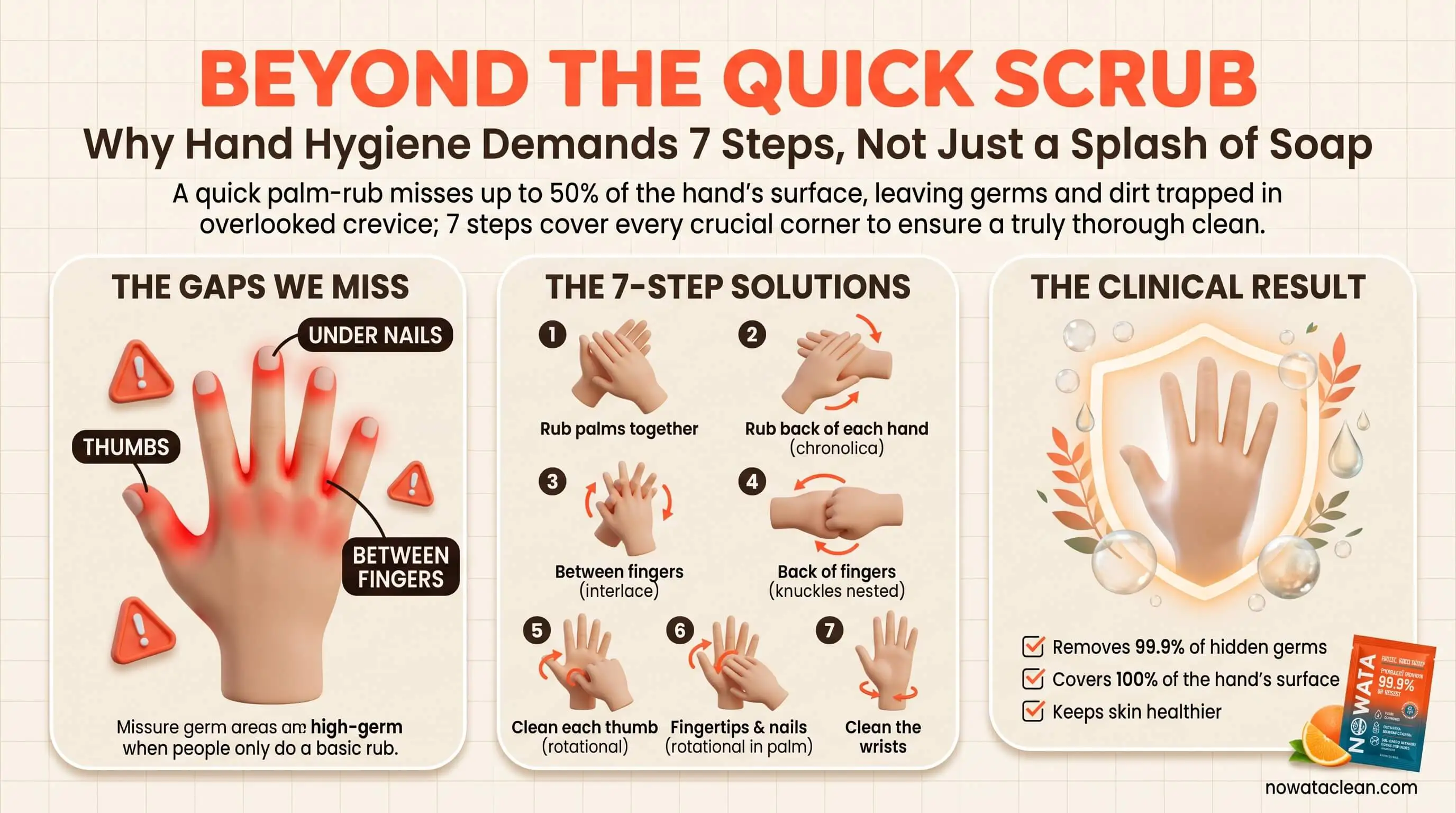
The 7 steps of hand hygiene are seven scrubbing motions, one for each part of the hand that a quick palm rub misses. Soap only removes germs where friction carries it, so the steps are a checklist for complete coverage.
Palms: rub palm to palm
Backs of hands: palm over the back of the other hand, fingers interlaced
Between fingers: palm to palm, fingers interlaced
Knuckles: backs of fingers against the opposite palm
Thumbs: clasp and rotate each one
Fingertips and nails: circle them on the opposite palm
Wrists: grip and rotate each one
Time: at least 20 seconds of scrubbing, then rinse and dry
Most missed: thumbs, fingertips, and the backs of the hands
No sink: the same seven motions work with rinse-free soap, which physically lifts dirt and germs off the skin rather than leaving them behind
Top Takeaways
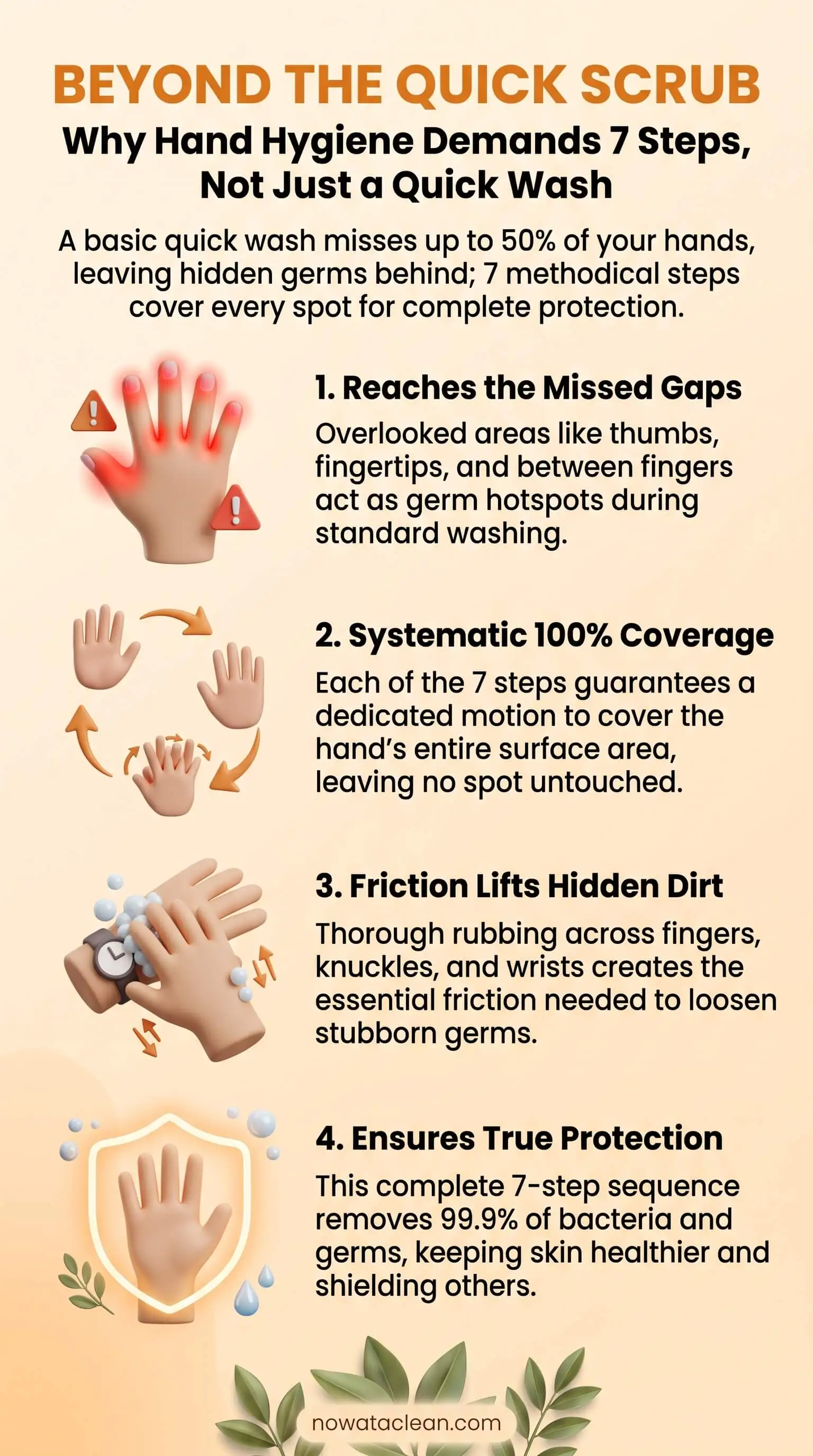
A quick palm rub misses most of your hand, because soap only cleans where you scrub it in.
Graham Ayliffe's team published the original six-step technique in 1978, and the WHO endorsed it in 2009.
Most seven-step lists add the wrists, a spot almost everyone skips.
Every step covers an area the others can't reach, from the backs of the hands down to the fingertips and nails.
Soap and water, alcohol rub, and rinse-free soap all use the same seven motions, so a missing sink doesn't have to mean skipped technique.
Why Soap Alone Isn't Enough
Soap loosens the oil that germs cling to, and scrubbing is what actually pulls them off your skin. The CDC's Handwashing Facts page explains that lathering creates the friction that lifts microbes, and that germs collect in especially high numbers under the nails.
So using soap tells you very little on its own. What matters is which parts of your hands got rubbed, and a palm-to-palm wash leaves almost everything except the palms alone.
Most of what I write here is about indoor air, and hand hygiene is where an air purifier stops helping. A good filter can pull fine particles out of a bedroom. It can't do a thing about the germs you carry from a gas pump handle to the sandwich in your lap. Your hands own that job. That's where proper handwashing with natural non toxic hand soap comes in.
Where the 7 Steps Came From
The steps started as six. In 1978, microbiologist Graham Ayliffe and his colleagues in Birmingham, England, published a hand washing technique for hospital staff that gave every surface of the hand its own motion. UK hospitals picked it up quickly, and the World Health Organization endorsed it in its 2009 hand hygiene guidelines. Read the longer history of hand washing, back to Ignaz Semmelweis in the 1840s, and you'll notice the rules get more specific every time someone checks what people miss.
The seventh step grew out of that same checking. Many hospitals and nursing schools add the wrists, since a wrist brushes against everything your palm touches and almost nobody scrubs it.
I should be upfront that lists don't all count the same way. Some make "wet your hands and apply soap" step one, which knocks a surface off the end. I only count the scrubbing motions here. Wetting comes before them and rinsing comes after.
The 7 Steps of Hand Hygiene, and What Each One Cleans
Wet your hands, use enough soap to cover every surface, and give these motions at least 20 seconds.
Step 1: Rub palms together. This cleans the palms, and for a lot of people it's the entire wash.
Step 2: Lay your right palm over the back of your left hand with fingers interlaced, then switch. The backs of your hands get skipped because they look clean whenever your palms do.
Step 3: Press palm to palm with your fingers interlaced. That reaches between the fingers, which stay shut during a fast rub.
Step 4: Lock your fingers and rub their backs against the opposite palm. Your knuckles need this one, and it's the motion most of us were never shown.
Step 5: Wrap each thumb in the opposite hand and rotate. Thumbs sit off to the side, so a palm rub slides right past them.
Step 6: Circle your fingertips against the opposite palm. Nails and fingertips carry some of the heaviest germ loads on the hand, so give this one a slow count.
Step 7: Grip each wrist and rotate. People tend to treat the wrist as outside the hand, even though it touches the same doorknobs.
Each step is there because the one before it can't reach that surface. Rinse under clean running water when you finish and dry with a clean towel.
How you wash is only half of it. When you wash matters just as much, and NOWATA's doctor-made guide to the 5 moments and 7 steps of hand hygiene lays out both, including how to keep the routine going when there's no water around.
The Spots Most People Miss
Trained professionals miss spots too. In a 2025 study published in the British Journal of Nursing, researchers had hospital staff wash with a lotion that glows under UV light anywhere the skin wasn't cleaned. On the first try, only 43% got all six Ayliffe steps right, and 59% missed the backs of their hands. After one short instructional video, 97% completed all six. The team then added a seventh step aimed at the backs of the hands and fingers.
What stays with me is how fast it improved. A few minutes of video took accuracy from under half to nearly everyone, which tells me the misses came from never being shown rather than from not caring.
Using the 7 Steps When There's No Sink
The motions stay the same when the sink disappears. The WHO teaches the identical rubbing sequence for alcohol-based hand rub, and rinse-free soaps follow it too.
What changes is where the germs end up. Alcohol gel kills germs chemically and leaves the dead germs and any dirt behind on your skin, and it struggles on hands that are visibly grimy. Rinse-free, plant-based formulas like NOWATA take the soap route instead. You rub through all seven motions until the formula clumps, then brush the clumps off, and the dirt and germs leave with them without a drop of water. If alcohol gel leaves your knuckles cracked, I also wrote up the least irritating hand sanitizer alternatives worth keeping in your bag.
"We spent two years building a soap that works without water, and the most useful thing we learned had little to do with chemistry. Parents already know the steps. Where it falls apart is the moment itself, a toddler at a picnic table with crackers already in hand and the restroom a five-minute walk away. Once you can run all seven motions right there, the technique finally gets used. Most of the missed thumbs and fingertips we watched happened because someone was rushing in the wrong place."
7 Essential Resources
These are the sources I'd hand a friend who wants to get the 7 steps right:
World Health Organization: Guidelines on Hand Hygiene in Health Care. The 2009 evidence review the WHO built its recommended technique on.
World Health Organization: Hand Hygiene, Why, How and When? Brochure. Simple diagrams of every motion. I'd print this one for a kitchen or classroom sink.
CDC: About Handwashing. Plain-language guidance on when to wash and why 20 seconds is the target.
CDC: Handwashing Facts. The CDC walks through the reasoning behind each part of the routine, lathering through drying.
StatPearls: Hand Hygiene. A peer-reviewed clinical review that compares soap and water with alcohol rub.
British Journal of Nursing: Handwashing Using a Modified Ayliffe Technique. The 2025 UV-light study that argued for a seventh step.
Wikipedia: Hand washing. How hand washing went from a disputed idea to standard practice.
3 Statistics
Under UV light, 59% of hospital staff in a 2025 study missed the backs of their hands, and only 43% performed all six Ayliffe steps correctly before watching a short training video. British Journal of Nursing
Handwashing education cuts the number of people who get sick with diarrhea by 23% to 40% and lowers respiratory illnesses like colds by 16% to 21%. CDC
In a 2025 national survey of 3,587 U.S. adults, 48% admitted they forget or choose not to wash their hands at key times. NFID
Final Thoughts and Opinion
Here's my take. The 7 steps of hand hygiene look fussy right up until you see what a quick wash leaves behind. I read them as a map of where germs hide on your hands, with one motion for every hiding spot.
Skipping a step reminds me of vacuuming the middle of a rug and calling the room clean. The edges still hold everything, and on your hands the edges happen to be the parts that touch your face and your food first.
The fix costs about 20 seconds a wash and one evening of practice with your family. After that it runs on autopilot. My one strong opinion is that a routine you can only do at a sink won't happen often enough, so keep some way to do it wherever you are.
Frequently Asked Questions
What are the 7 steps of hand hygiene?
Rub your palms together, rub the back of each hand with fingers interlaced, then rub palm to palm with fingers interlaced. Next, rub the backs of your fingers against the opposite palm, rotate each thumb in the opposite hand, circle your fingertips on the opposite palm, and finish by rotating each wrist. Wet your hands and apply soap before you start, and rinse and dry when you're done.
Why is it 7 steps and not 6?
The original 1978 Ayliffe technique, the one the WHO endorsed, has six steps. Many hospitals and nursing programs add the wrists as a seventh, since they touch everything your hands do and rarely get scrubbed. Other lists get to seven by counting "wet hands and applying soap" as step one.
How long should the 7 steps of hand washing take?
Give the scrubbing at least 20 seconds, roughly two rounds of "Happy Birthday" hummed under your breath. The CDC notes that washing for about 15 to 30 seconds removes more germs than shorter washes. Rinsing and drying come after.
Which step do people skip most often?
Thumbs, fingertips, and the backs of the hands get missed most. In a 2025 UV-light study of hospital staff, 59% missed the backs of their hands on the first try. A palm-to-palm rub barely touches any of those spots.
Do the 7 steps apply to hand sanitizer?
Yes. The WHO uses the same rubbing motions for alcohol-based hand rub, and you keep going until your hands are dry. Rinse-free soaps follow the same sequence. Whatever you're using, the motions are what spread it across every surface.
How do I teach the 7 steps to kids?
Walk through the steps together once, slowly, and name each one out loud. Kids get it fastest when you tell them to rub like they're pulling on invisible gloves, every finger and both wrists. A printed poster by the sink helps, and so does practicing at snack time. For little ones with sensitive skin, a hypoallergenic hand soap makes all that washing easier on their hands.
Make Every Step Count, Sink or No Sink
You've got the seven motions down, so give them a chance to happen wherever your day goes. Tuck a rinse-free, plant-based soap into the car or the diaper bag for the times a sink is out of reach, and grab a gentle hypoallergenic hand soap for the little hands at home.